Species of the week: Cymbidium goeringii 'Tian Cao' (天草)
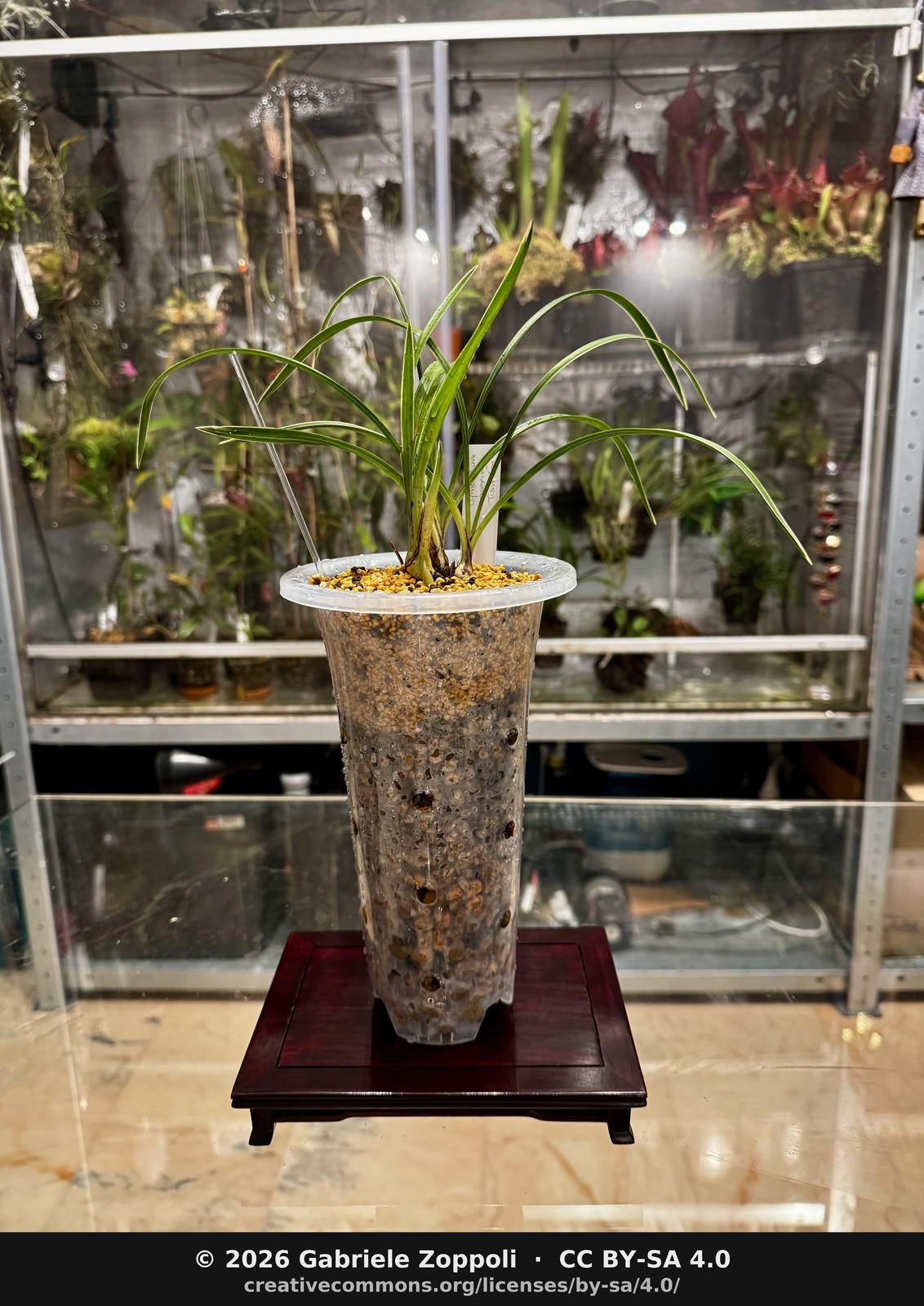
The Chinese spring orchid, a cream-margined Amakusa selection grown for foliage and scent. Repotted into a tall clear Chinese pot on sieved Japanese grit.
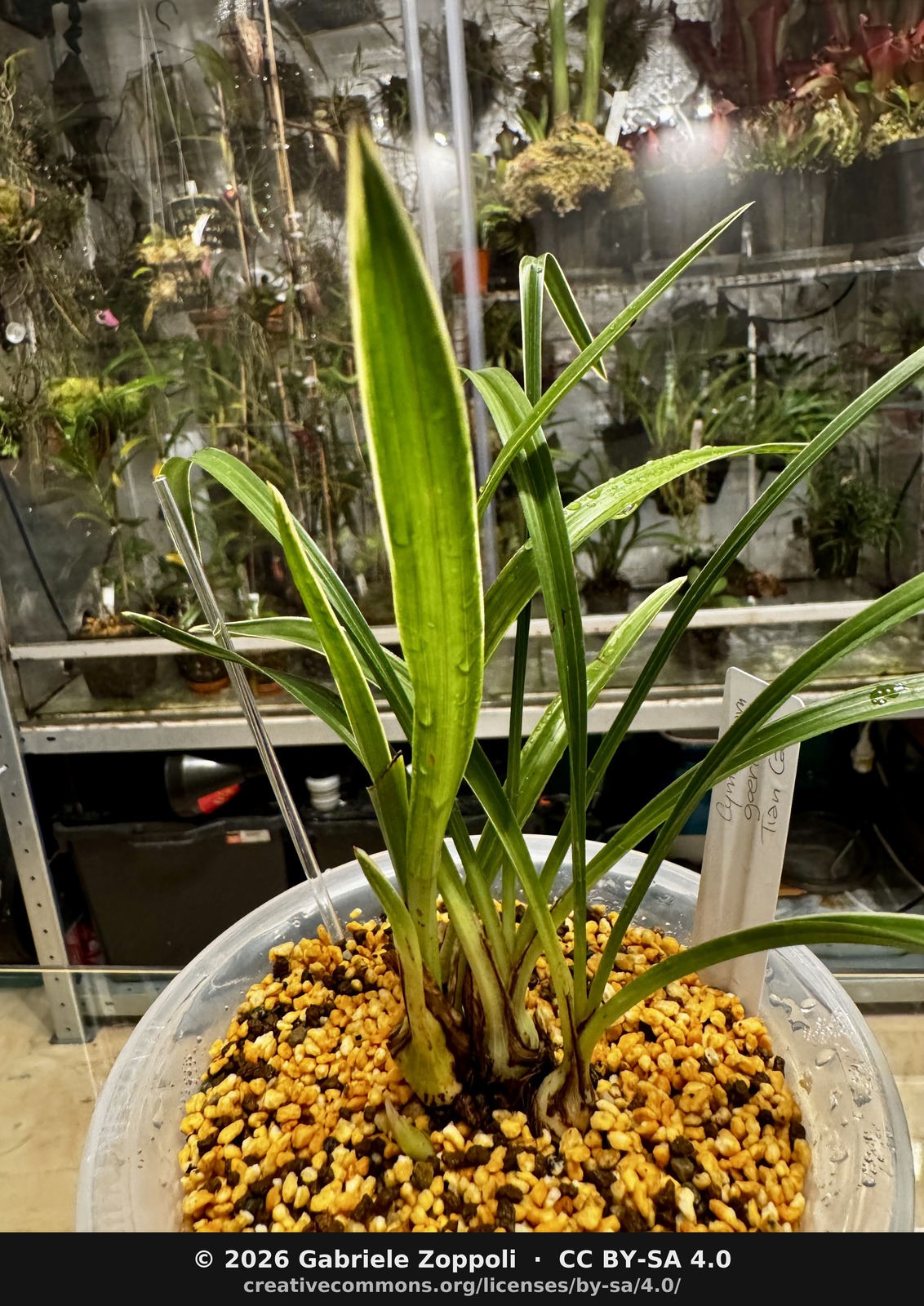
A grassy terrestrial in a tall clear pot, on a wooden stand. Cymbidium goeringii is the Chinese spring orchid, in cultivation for more than a thousand years, prized for foliage and scent. ‘Tian Cao’ is a cream-margined selection. Repotting it turned into its own project.
The name
- Genus Cymbidium. Olof Swartz, 1799. Greek for “little boat”, after the hollow of the lip.1
- goeringii. For Philipp Friedrich Wilhelm Goering (1809–1876), a German collector. Reichenbach described it as Maxillaria goeringii in 1845 from Japanese material, then moved it to Cymbidium.2
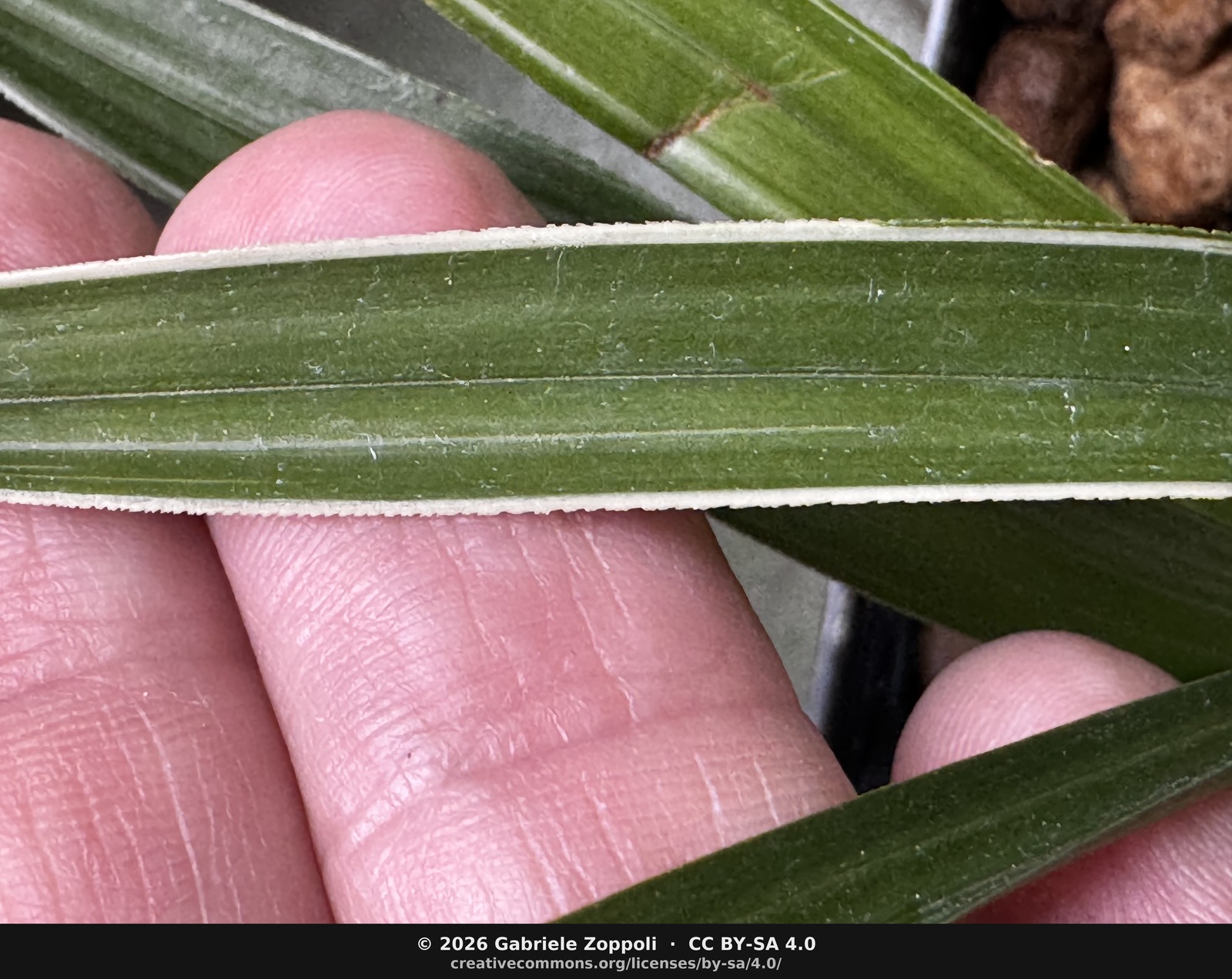
- ‘Tian Cao’ (天草). Literally “heaven grass”. The two characters read Tiān Cǎo in Mandarin and Amakusa in Japanese, the name of a town on Kyushu the selection is said to come from. A Japanese shunran, then, wearing its Mandarin reading. Its cream leaf margin is a fukurin, a contrasting-edge variegation.3
One plant carries a German surname, a Mandarin reading, and a Japanese place name.
Where it’s from
POWO maps it across China, the Himalaya, Japan, Korea, Myanmar and Vietnam.2 IOSPE also lists Taiwan and the Ryukyus.4 A woodland terrestrial of shaded, often rocky slopes, rooting in thin humus over rock. Small ovoid pseudobulbs, linear leaves with finely toothed margins, the serration running right down the cream edge.
The spring orchid
Chunlan (春兰) in Chinese, shunran (春蘭) in Japanese, both “spring orchid”. It is among the longest-cultivated of the Chinese cymbidiums, grown in the guolan (国兰, “national orchid”) tradition for fragrance and leaf form rather than display.5 The flower is plain. Usually one per scape (rarely two or three), pale yellow-green veined purple-brown, held low among the leaves, out in winter and early spring.4 The scent does the work, variously described as jasmine, lily-of-the-valley, or lemon. Hundreds of named selections exist, the dwarf, the lotus-petalled and the variegated among the most prized.
The repot
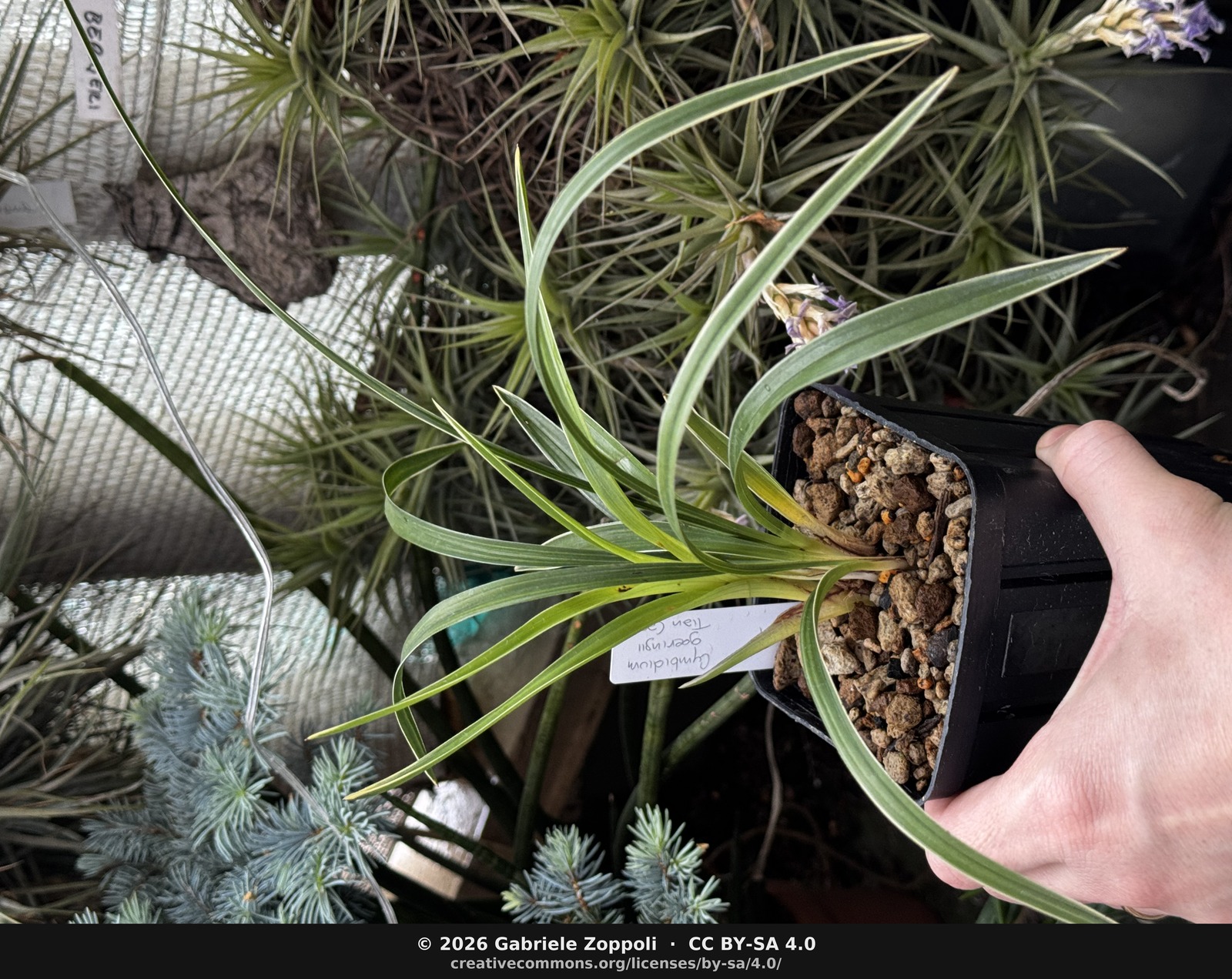
Orticola, this May, from Piante Pazze. It came in a black nursery pot. I grew it on for a month, then repotted, and found some roots had rotted under the surface, the kind of thing a black pot hides until it spreads. New root tips were pushing too, and two new growths.
The new pot is a clear-plastic Chinese cymbidium pot, tall and narrow, 135 mm at the rim, the walls pierced with holes. Around €10 for five off AliExpress, and not something I could find in Europe. The shape fits the deep, fleshy cymbidium roots, and the holes and clear wall give drainage, air, and a window on roots and moisture.
Substrate from Geosism, all sieved first.6 A startling amount of dust, so do it outside with a mask. Three grades, coarse to fine, bottom to top:
- 10 mm kiryuzuna at the bottom, a hard iron-rich volcanic sand, sharp-draining and slow to break down.
- a 2–5 mm bonsai mix in the middle, mostly akadama with kiryuzuna and hyuga pumice.
- 1–2 mm kanuma on top, an acidic pumice that holds water.
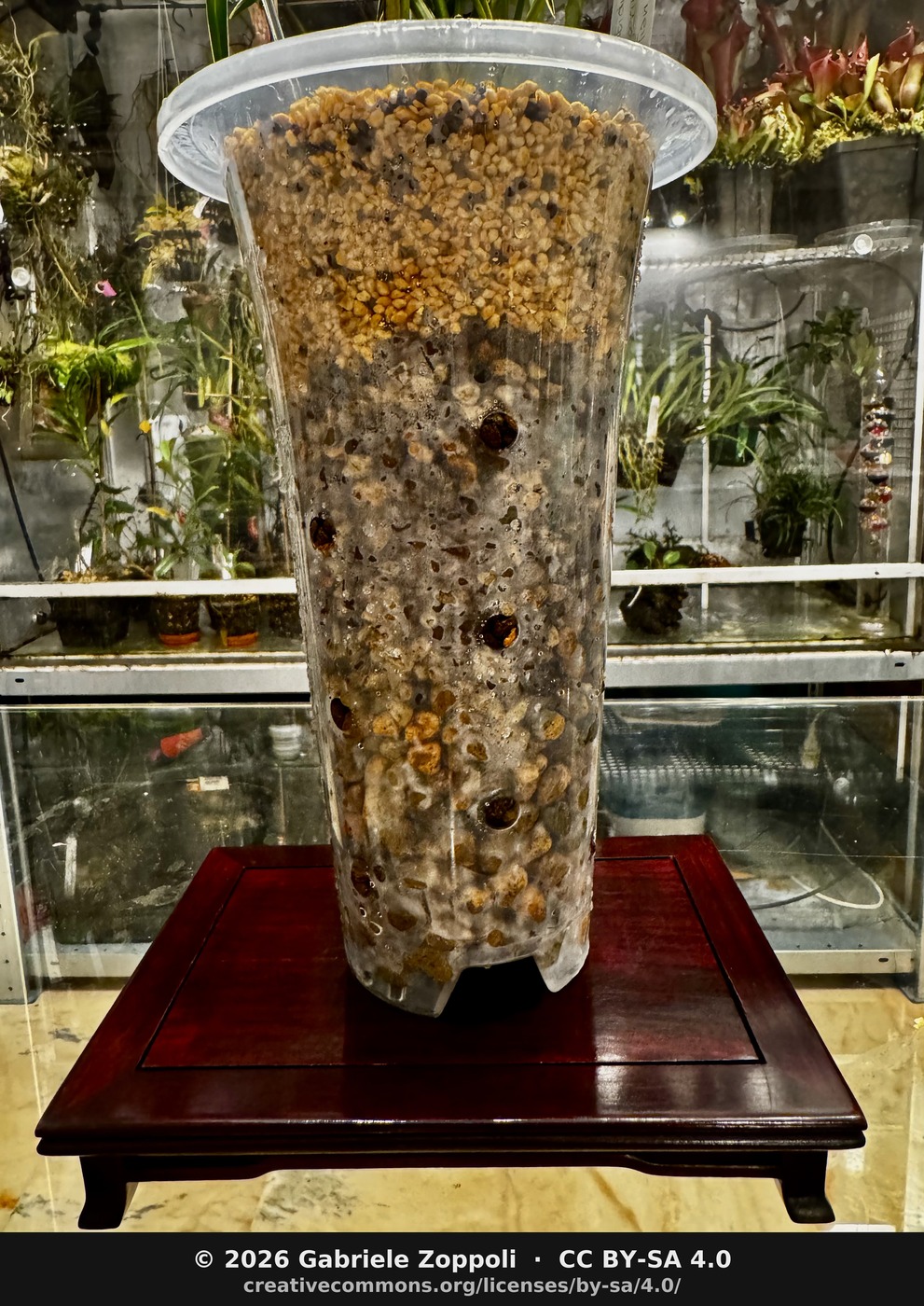
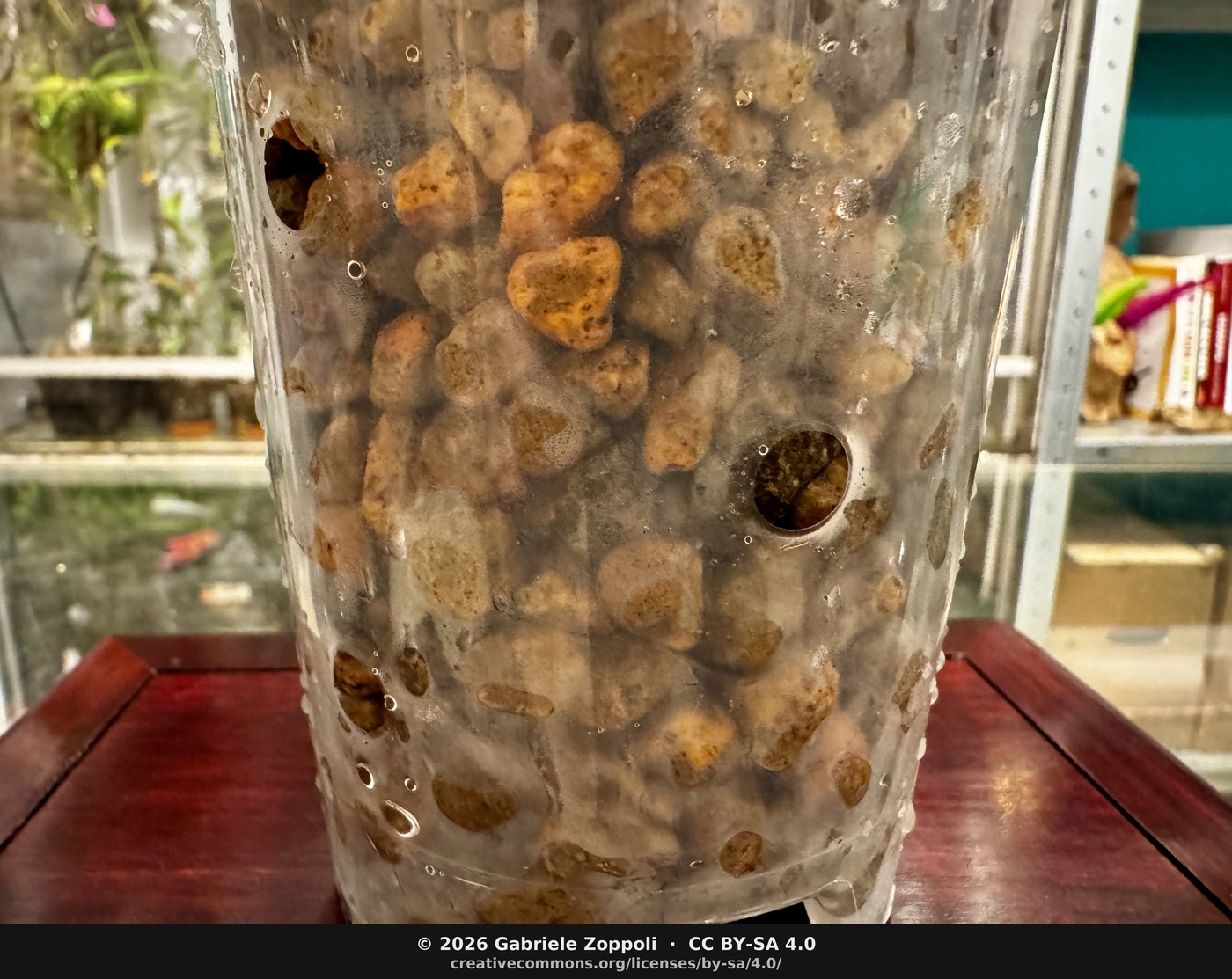
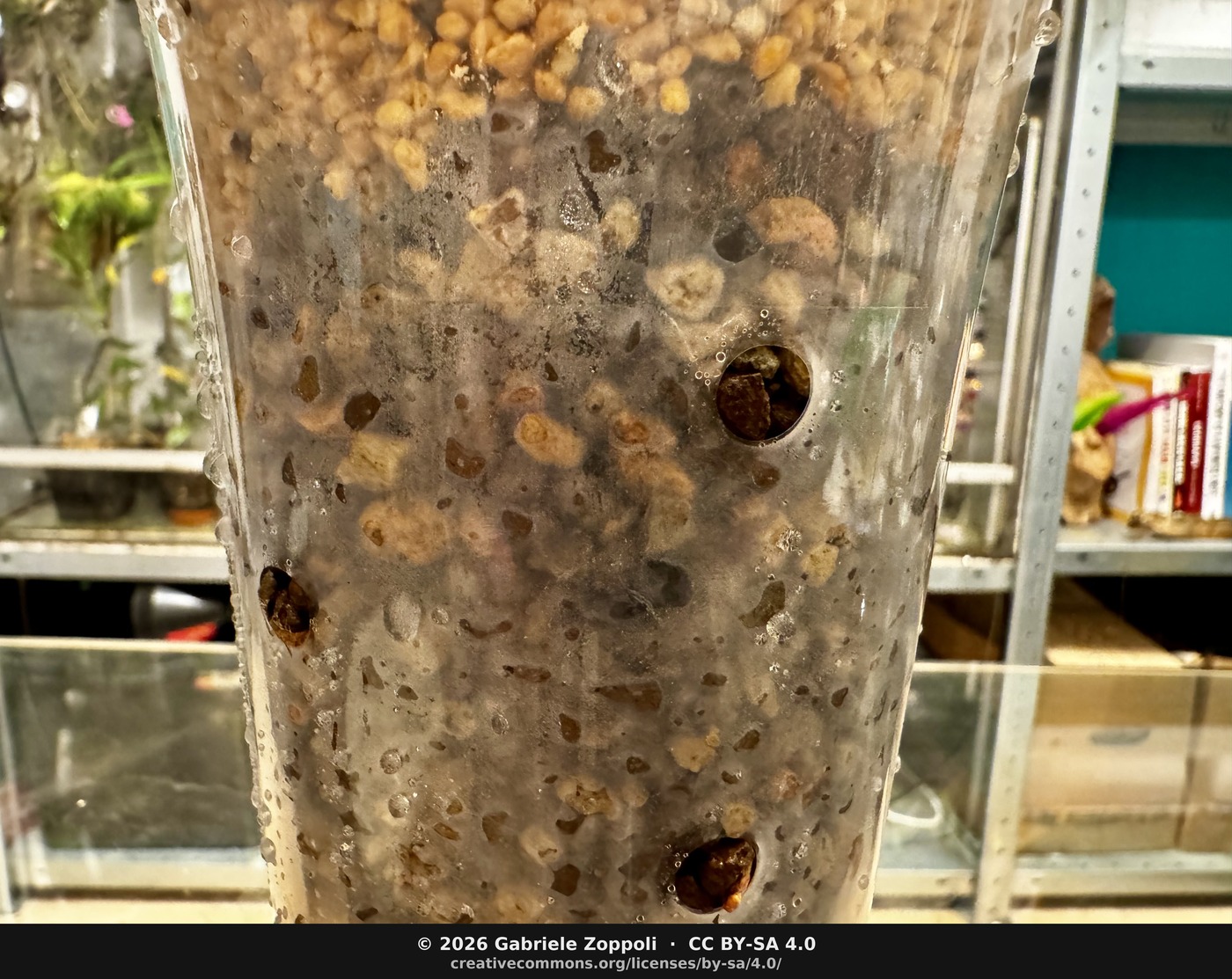
The kanuma doubles as the water gauge. It pales as it dries, darkens when wet, and the clear wall shows the condensation low in the pot. I water through every 3–4 days, once the top kanuma has gone dry and that condensation is fading.
On the rim, moss off a west-facing asphalt car park in Genoa, the kind that bakes in afternoon sun and survives, so it should take a sunny windowsill. Washed, then dipped in tebuconazole. A few fungus gnats hatched out of it, but a couple of days in filtered open-air sun cleared them.
Growing it
- Cool-growing terrestrial. Bright light, not scorching sun. On the floor at a south-facing door-window through summer, then outdoors from September until late spring.
- A cold winter rest is not optional. Flower buds need roughly 5–10 °C, or they abort.7 The Genoa winter, spent outdoors, delivers it.
- Water by the kanuma-and-condensation cue, every 3–4 days in growth. The grit drains hard and fast. Cymbidium roots rot wet.
- Inorganic mix, perforated pot, airy pseudobulbs, all for air and drainage.
Links
- POWO — Cymbidium goeringii. Accepted name, authority, distribution.
- IOSPE — Cymbidium goeringii. Jay Pfahl; morphology, range, scent, cultivation.
- Yang et al. (2019), BMC Genomics. The low-temperature requirement for flowering.
- New World Orchids — ‘Tian Cao’ 天草. Notes on the Amakusa selection.
- Piante Pazze. Marco Toffoletti’s nursery near Udine, hardy outdoor orchids. Where this plant came from.
Species of the week is a rolling series. Past entries under the species-of-the-week tag; per-species page with provenance + photos at /collection/species/cymbidium-goeringii-tian-cao/.
Wikipedia — Cymbidium. Genus erected by Olof Swartz, 1799 (Nova Acta Regiae Soc. Sci. Upsal.); the name means “little boat-shape”, referring to the labellum. ↩︎
POWO — Cymbidium goeringii (Rchb.f.) Rchb.f. Basionym Maxillaria goeringii Rchb.f., Bot. Zeitung (Berlin) 3: 334 (1845); combination in W.G.Walpers, Ann. Bot. Syst. 3: 547 (1852). Native range (verbatim): “China North-Central, China South-Central, China Southeast, East Himalaya, Japan, Korea, Myanmar, Nepal, Vietnam, West Himalaya”. ↩︎ ↩︎
New World Orchids and grower references — Cymbidium goeringii ‘Tian Cao’ 天草. The characters mean “heaven grass”; read Tian Cao in Mandarin, Amakusa in Japanese (Amakusa being a town on Kyushu the selection is reportedly named for). A fukurin (margin-variegated) shunran with a cream leaf-edge; also traded as Amakusa. ↩︎
IOSPE (Jay Pfahl) — Cymbidium goeringii. “A native of northwestern India, Bhutan, China, Taiwan, Ryukyu Islands, Japan and Korea as a smaller, cool growing terrestrial”; small ovoid pseudobulbs; “linear-elliptic, acute, arched leaves with fine toothed margins”; flowers ~5 cm, “solitary to few [1 to 3] flowered”, winter and spring, “fragrant jasmine, lily of the valley to lemon scented”, held low amid the leaves; common name “Goering’s Cymbidium [German Plant Collector in Japan 1800’s]”; Shun-ran (Japan) / Chun Lan (China). ↩︎ ↩︎
Chinese cymbidium (guolan, 国兰, “national orchid”) literature — C. goeringii is among the longest-cultivated of the Chinese cymbidiums (recorded for more than a thousand years), grown for fragrance and foliage; usually a single fragrant flower per scape; hundreds of cultivars, with dwarf, lotus-petalled and variegated forms among the most prized. ↩︎
Japanese substrate references. Kanuma — acidic pumice (pH ~4.5–5.5) from Kanuma, Tochigi; pale/whitish when dry, brownish-yellow when wet (a built-in watering indicator). Kiryuzuna — hard, iron-rich (Fe₂O₃) volcanic sand from Kiryu, Gunma; sharp drainage, resists compaction and breakdown. Akadama — granular Japanese volcanic clay; water and nutrient retention. Hyuga — washed white pumice from Miyazaki, near-neutral pH. The 2–5 mm middle grade is Geosism’s pre-sieved blend, ≈ 60% akadama / 20% kiryuzuna / 20% hyuga. ↩︎
Yang, F., Zhu, G., Wei, Y., Gao, J., Liang, G., Peng, L., Lu, C. & Jin, J. (2019). Low-temperature-induced changes in the transcriptome reveal a major role of CgSVP genes in regulating flowering of Cymbidium goeringii. BMC Genomics 20: 53. Verbatim: “It blooms in winter during January–March and a period of low temperature is necessary for its normal flowering, otherwise there is flower bud abortion”; cold treatment around 5–10 °C. [DOI 10.1186/s12864-019-5425-7]. ↩︎
Comments
Thoughts, corrections, trade offers welcome. Comments live on GitHub Discussions; sign in with a GitHub account to post.