Species of the week: Dracula pholeodytes
A Colombian cold-grower that's mostly tails. Thumbnail-sized cup with a pale monkey face inside; three sepal tails spanning 10–15 cm.
Dracula pholeodytes is mostly tails. A thumbnail-sized maroon-speckled cup holds a pale monkey face; the three sepals taper off into caudae spanning 10–15 cm across three directions.
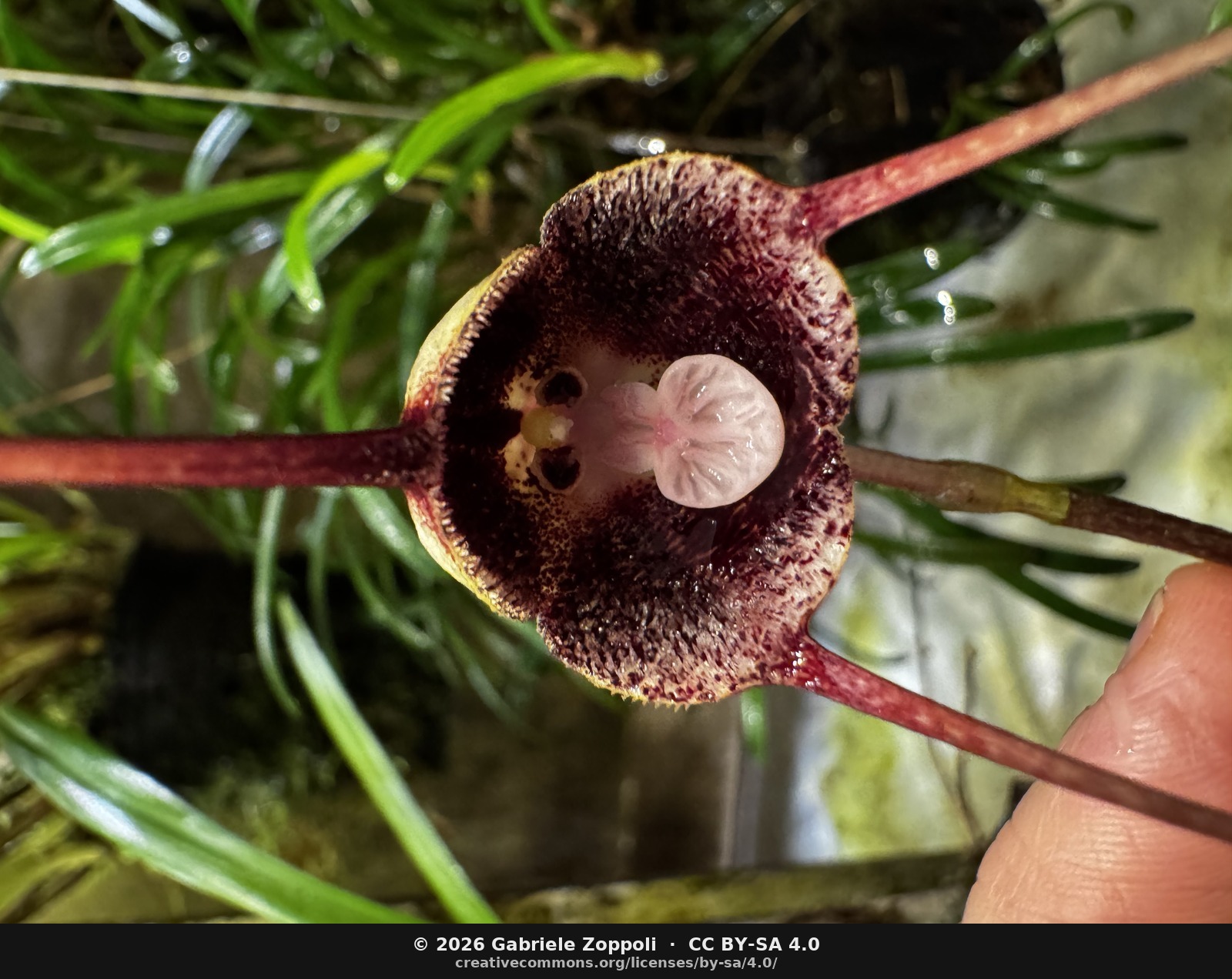
Tails vs. petals
The long thin structures are caudae (singular cauda, “tail”) — tips of the sepals, not petals. Petals in Dracula are the two small lobes flanking the column inside the cup. IOSPE measures the whole flower at 1.5 × 6 in (3.75 × 15 cm); most of that 15 cm is cauda.1
The name
Pholeodytes = pholeos (cave) + dytes (diver). The monkey face sits deep inside the cup rather than at the front, as in simia, gigas or vampira. Cave-diver.
Where from
NE Colombia, Boyacá department, eastern slope of the Andes. Not the Chocó. POWO gives the range as “NE. Colombia”.2 Around 2,500 m. Cold-growing per IOSPE — cold, not cool.1
Described by Luer & Escobar, Selbyana 7: 68 (1982),2 four years after Luer split Dracula from Masdevallia.
How mine got here
Ecuagenera, early 2023, as a small division on sphagnum. Took a year to settle. In a 10 cm black plastic basket in bark now, hanging in the lower right of the highland cabinet below the Heliamphora.
Growing it
- 12–15 °C minimum at night. Above 18 °C it cooks.
- 85–98 % RH.
- Constant airflow.
- Rainwater or RO only; sphagnum never dries.
- Full shade.1
No workaround without a refrigerated cabinet.
Notes
- Several Dracula species look and smell like mushrooms and are pollinated by fungus-infesting flies. Endara, Grimaldi & Roy (2010) documented this for D. lafleurii.3 The labellum on pholeodytes looks gilled-mushroom-like too; no direct fieldwork on this species.
- “Monkey face” applies to the whole genus, not just simia. In pholeodytes the face sits further back in the cup — hence cave-diver.
- The eastern slope of the Colombian Andes exports far fewer orchids to cultivation than the Chocó on the Pacific side.
Links
- POWO — distribution + authority.
- IOSPE — morphology + cultivation.
- Ecuagenera — source.
- Endara, Grimaldi & Roy (2010). Lankesteriana 10(1): 1–11 — open-access PDF.
Species of the week is a rolling series. Past entries under the species-of-the-week tag; per-species page with provenance + photos at /collection/species/dracula-pholeodytes/.
Pfahl, J. Internet Orchid Species Photo Encyclopedia. http://www.orchidspecies.com/dracpholeodytes.htm ↩︎ ↩︎ ↩︎
Plants of the World Online. Dracula pholeodytes Luer & R.Escobar. https://powo.science.kew.org/taxon/urn:lsid:ipni.org:names:84003-2 (accessed 2026-04-23). ↩︎ ↩︎
Endara, L., Grimaldi, D.A. & Roy, B.A. (2010). Lord of the flies: pollination of Dracula orchids (Orchidaceae; Pleurothallidinae) by mushroom-infesting flies (Drosophilidae). Lankesteriana 10(1): 1–11. ↩︎
Comments
Thoughts, corrections, trade offers welcome. Comments live on GitHub Discussions; sign in with a GitHub account to post.