Species of the week: Dracula Raven 'Jet'
A primary hybrid of D. vampira × D. roezlii — three almost-black sepal tails, yellow gilled center, pink labellum. Registered 2005 by J. Leathers.
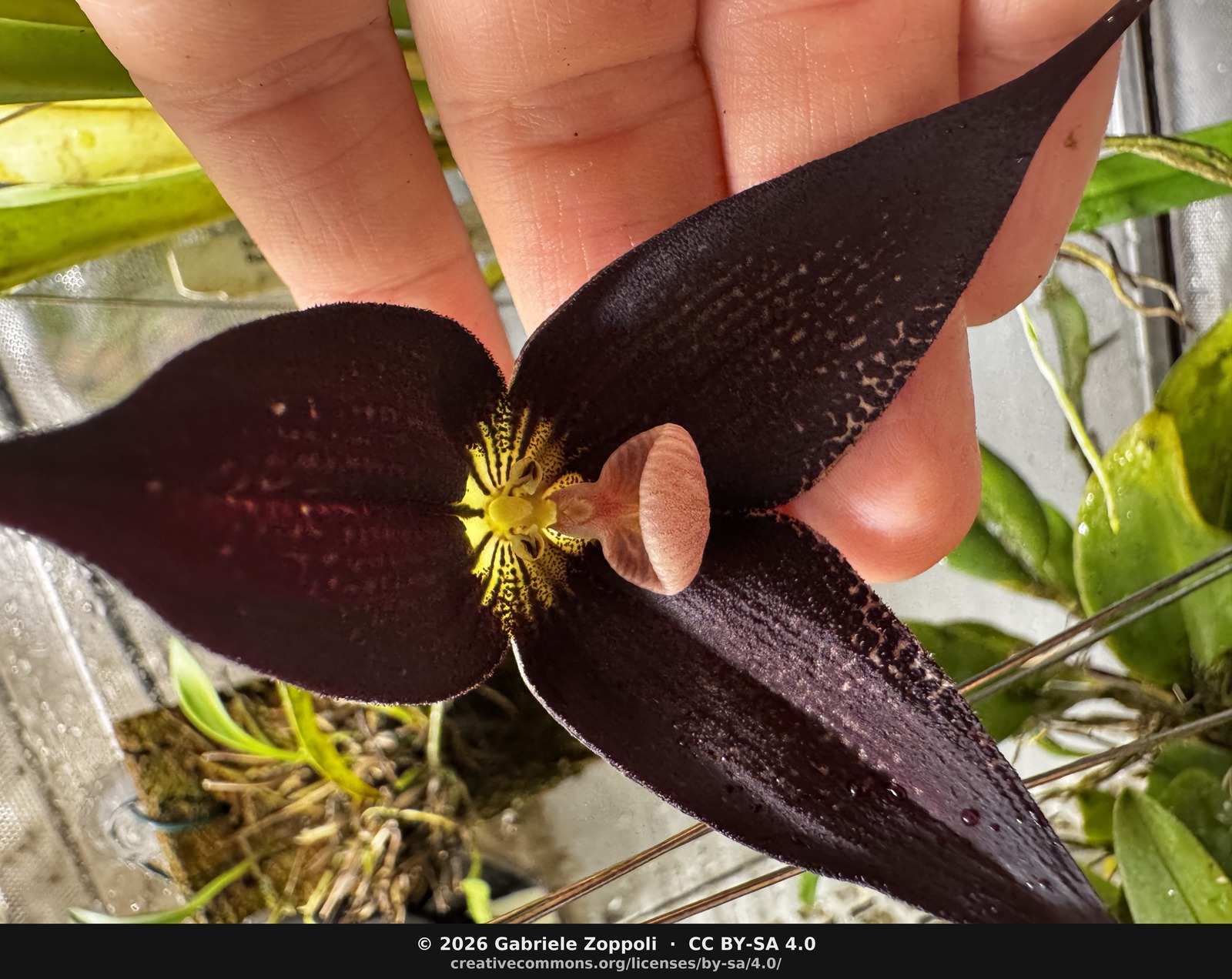
Dracula Raven ‘Jet’ is a primary hybrid. D. vampira × D. roezlii. Three sepal tails that read as pure black at arm’s length, a yellow gilled center, and a small pink labellum sitting like a mushroom cap in the middle.
Sepals, not petals
In Dracula the three big tail-bearing organs are sepals, fused at the base into a small cup. Petals exist — two of them — but they sit tiny and inconspicuous inside the cup, flanking the column. Everything you see in the hero photo above is sepal, sepal, sepal, plus the yellow column and the pink labellum.
The grex
Registered with the RHS in 2005 by J. Leathers.1 Primary hybrid — both parents are species, no further crosses in the pedigree. Vendors keep calling it “the blackest of all the Draculas”; the framing is marketing, but the pigmentation is real enough that the claim does the rounds in the trade.
The grex name Raven and the cultivar name ‘Raven’ FCC/AOS are different things — easy to confuse. The cultivar ‘Raven’ is one selected clone within the Raven grex; it picked up an FCC from the AOS. ‘Jet’, ‘Lenore’ and others are sibling clones from the same crosses. Mine carries the ‘Jet’ tag from Ecuagenera.
The name
- Genus Dracula — Luer, 1978. “Little dragon”, from the look of the elongated sepal tails and the monkey/vampire face inside the cup.
- vampira — vampire. The dark veining over a green sepal base reads that way under most lighting.
- roezlii — honoring Benedikt Roezl (1824–1885), Czech orchid collector. Discovered 800+ orchid species across the Americas, lost a hand in a sugarcane accident in Havana, founded the journal Flora in 1880.2
- ‘Jet’ — color name. With one footnote: pure jet (lignite) is a warm brown-black, not a neutral one. So the cultivar name is more accurate than it sounds.
On the color
Not jet black. Held against a Pantone palette, the closest match is “Chocolate Plum” — a very dark warm red-brown. Definitely not a neutral black: a clear red bias right through the whole sepal field. Dried Amarone, not ink.
The lower sepal reads as oxblood/garnet under cabinet light — the D. roezlii contribution. The other two go almost-black with reddish veining, which is D. vampira’s.
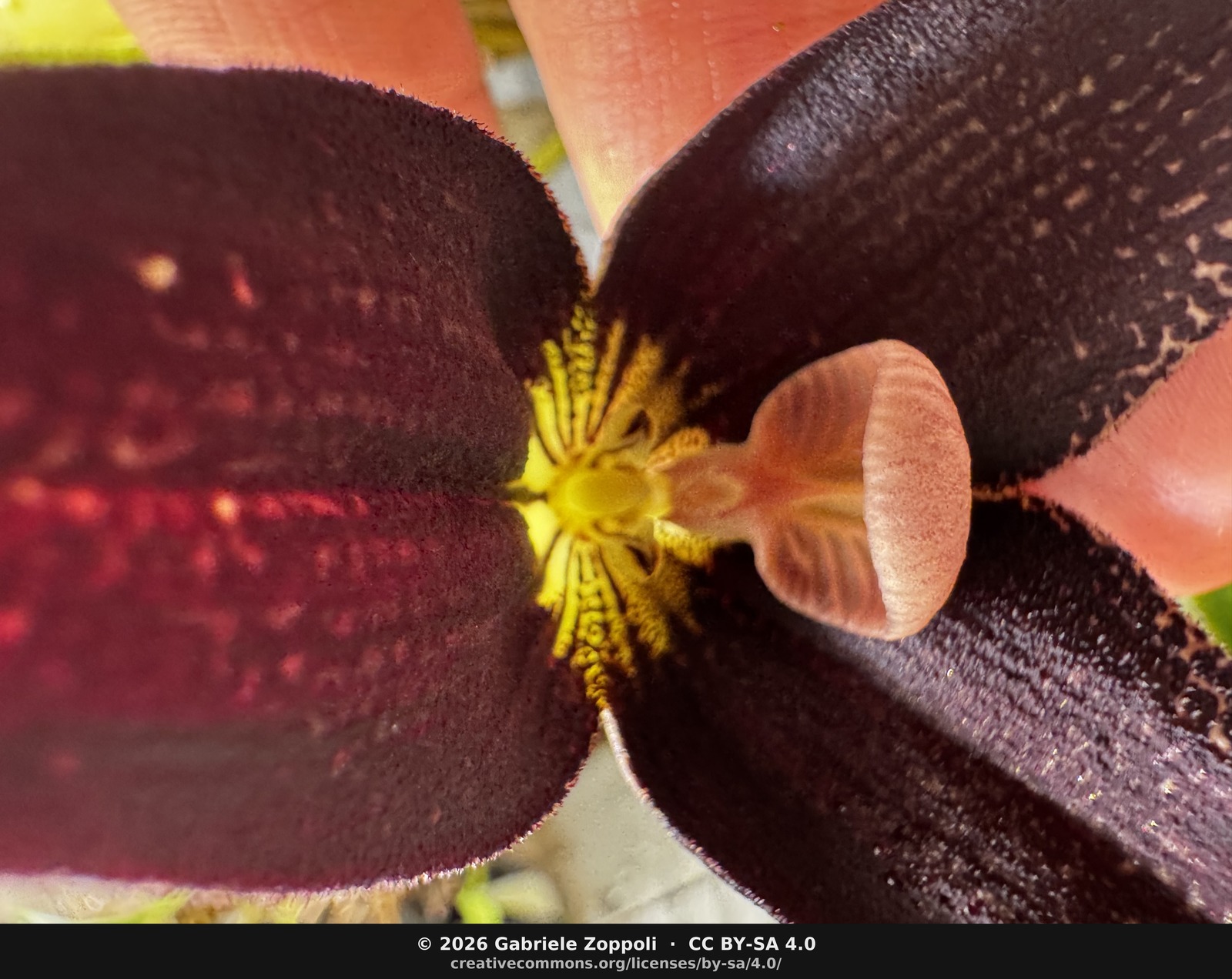
The papillae are easy to miss at a distance but obvious in macro: small, scattered, almost lime-yellow, concentrated where each sepal meets the cup. All three sepals carry them.
Where the parents are from
Dracula vampira — Pichincha province, Ecuador. 1,800–2,200 m on the western slope of the Andes. Cool to cold cloud forest, deep shade. Published as (Luer) Luer in Selbyana 2: 198 (1978), four years before Luer split Dracula off from Masdevallia.34
Dracula roezlii — Western Colombia. (Rchb.f.) Luer in Selbyana 2: 197 (1978).5 Same year as the vampira recombination — Luer was reshuffling the genus wholesale.
So the parents straddle the Ecuador–Colombia border, both on cloud-forest middle elevations of the Andes. Not the same population; same biome.
How mine got here
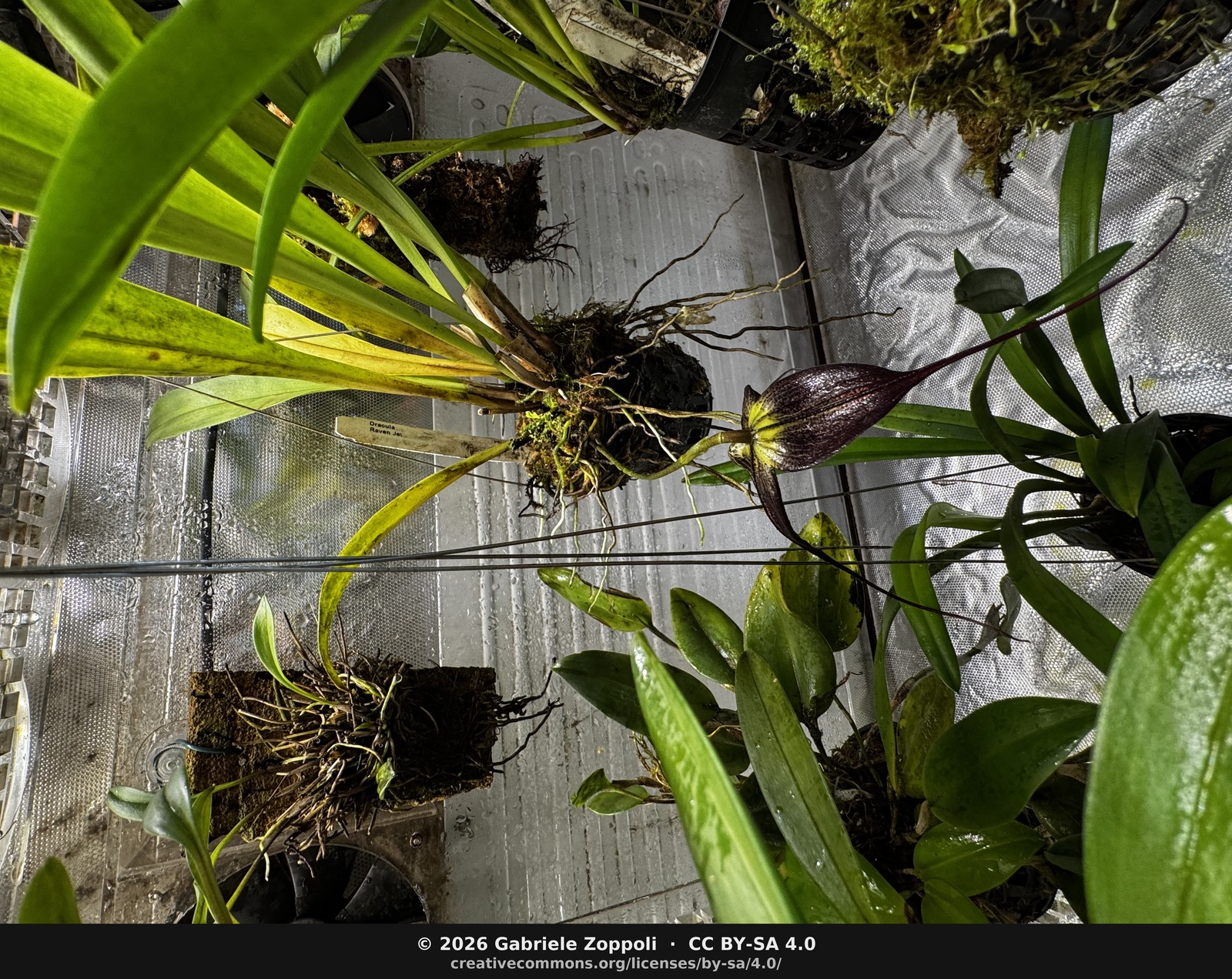
Ecuagenera. Arrived as a division, roots wrapped in long-fibre sphagnum for shipping. Now in a hanging basket on pure long-fibre sphagnum. Has bloomed annually since it settled — flowers come from pendant inflorescences pushing down through the sphagnum, the way most Dracula do.
Growing it
- 12–18 °C at night. Above 20 °C for any stretch and the next flush aborts.
- 85–98 % RH.
- Constant airflow — both parents come from places where mist sits but never stagnates.
- Rainwater or RO only. Sphagnum never dries, never stays sodden either.
- Deep shade. D. vampira in habitat is in the dimmest stratum of the cloud forest.
- Hanging basket on pure long-fibre sphagnum, no mix — pendant flowers need room to push past the substrate.
Lives in the lower right of the highland cabinet, next to D. pholeodytes and below the Heliamphora.
Notes
- Fungus-gnat pollination is documented for one Dracula species (D. lafleurii) — sepals and labellum mimic gilled mushrooms, attracting Drosophilidae that breed in fungal fruiting bodies.6 No fieldwork on Raven or either of its parents, but the labellum shape on this hybrid is unmistakably mushroom-like.
- Primary hybrids of Dracula tend to be vigorous and more forgiving than either parent. D. vampira in particular is notorious for sulking in cultivation; Raven inherits the look but is closer to D. roezlii’s temperament.
Links
- POWO — D. vampira and D. roezlii — authorities + distribution.
- IOSPE — D. vampira — morphology + cultivation for the Ecuadorian parent.
- Ecuagenera — source nursery, propagates both parents and the Raven grex.
- Endara, Grimaldi & Roy (2010). Lankesteriana 10(1): 1–11 — open-access PDF — the fungus-gnat pollination paper.
Species of the week is a rolling series. Past entries under the species-of-the-week tag; per-species page with provenance + photos at /collection/species/dracula-raven-jet/.
International Orchid Register, Royal Horticultural Society. Dracula Raven, originator J. Leathers, registered 2005. Parentage D. vampira × D. roezlii. ↩︎
Wikipedia, Benedikt Roezl. 13 August 1824 – 14 October 1885. Czech botanist and orchid collector. ↩︎
Plants of the World Online. Dracula vampira (Luer) Luer, Selbyana 2: 198 (1978). https://powo.science.kew.org/taxon/urn:lsid:ipni.org:names:84027-2 (accessed 2026-05-15). ↩︎
Pfahl, J. Internet Orchid Species Photo Encyclopedia. Dracula vampira. http://www.orchidspecies.com/dracvampira.htm ↩︎
Plants of the World Online. Dracula roezlii (Rchb.f.) Luer, Selbyana 2: 197 (1978). https://powo.science.kew.org/taxon/urn:lsid:ipni.org:names:84015-2 (accessed 2026-05-15). ↩︎
Endara, L., Grimaldi, D.A. & Roy, B.A. (2010). Lord of the flies: pollination of Dracula orchids (Orchidaceae; Pleurothallidinae) by mushroom-infesting flies (Drosophilidae). Lankesteriana 10(1): 1–11. ↩︎
Comments
Thoughts, corrections, trade offers welcome. Comments live on GitHub Discussions; sign in with a GitHub account to post.