Species of the week: Heliamphora macdonaldae
A pitcher plant from a single Venezuelan tepui. Found in 1928, sunk into Heliamphora tatei in 1978, reinstated in 2011 — and named for a woman of mysterious identity.
Heliamphora macdonaldae is a tepui endemic that spent thirty years hidden inside another species and is named for a woman of mysterious identity. Yellow-green pitchers to about 30 cm, taller examples close to 40, with a low waist that drains overflow and crimson veins running across a glabrous interior. The nectar spoon on top is small and dark red.1
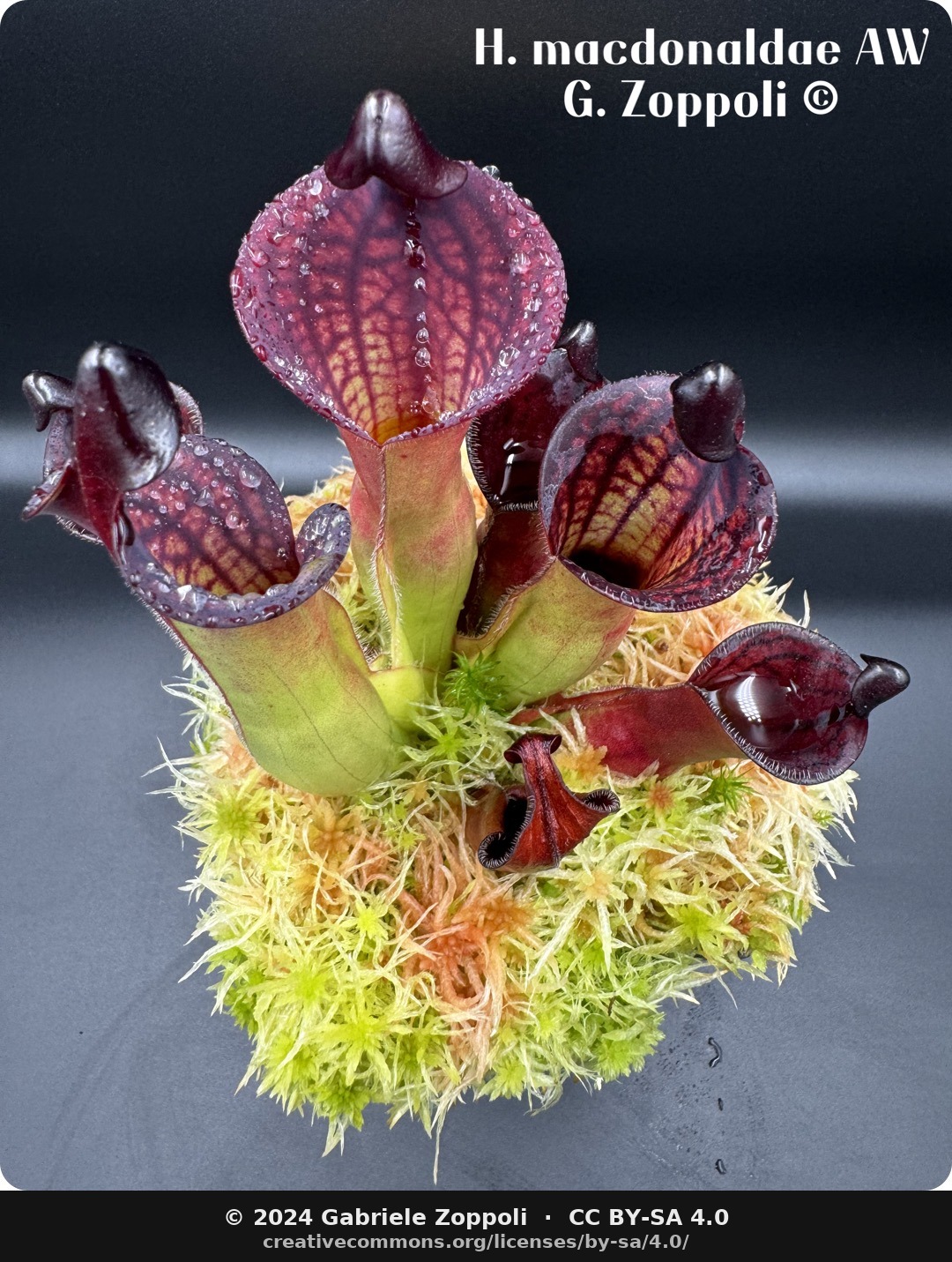
The pitcher
Compact rosette, ground-level, no climbing stem — that’s how macdonaldae looks in cultivation. In the wild on Cerro Duida it can reportedly elongate, but never to the extent of H. tatei, which is the only stem-forming species in the genus.2 The interior wall is smooth except for a fringe of spine-like hairs at the rim. Crimson veining on a yellow-green ground is the signature; some clones flush almost solid red.1
The drainage hole at the lower waist matters. Heliamphora don’t dose their pitchers with enzymes the way Sarracenia or Nepenthes do — most rely on commensal bacteria to digest prey, and on the drainage hole to dump excess water during heavy rain.3 Tate noted this hole during the 1928 expedition and recorded it in the same paper that named the species.4
Cerro Duida
Single tepui, Venezuelan Amazonas, peak at 2,358 m, summit plateau spread across 1,089 km².5 Sandstone block rising abruptly from rainforest. Macdonaldae sits at 1,500–2,300 m on the summit and surrounding hills.1
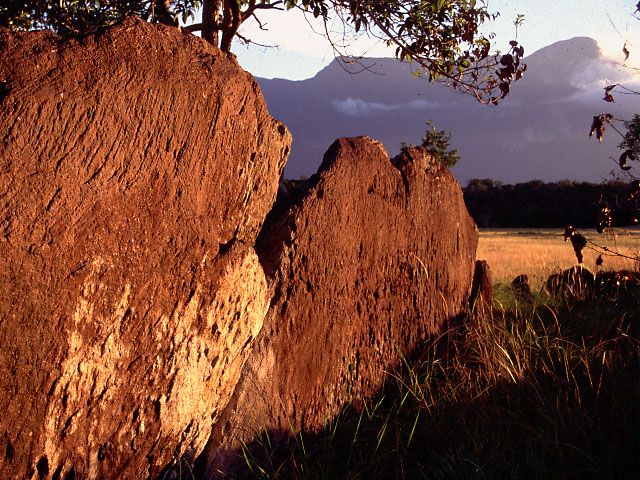
The green plateau in the satellite view is the summit; everything around it is lowland Amazon. (Open in Google Maps)
Tepuis, briefly
About 115 of these flat-topped sandstone islands rise above the Guiana Shield in Venezuela, Guyana and Brazil. Precambrian quartz arenite, eroded since roughly 70 million years ago, weathered for so long that the summits are nutrient-poor and acidic. Roughly 42 % of vascular plant species recorded on tepuis are endemic to them.6 Carnivorous plants do well in the leached soils — Heliamphora, Brocchinia, Drosera, Utricularia, Genlisea. Cerro Duida hosts several. The genus Heliamphora is functionally restricted to this archipelago.
The expedition that found it
The summit of Mount Duida was unclimbed by Western expeditions until 1928. Humboldt and Bonpland viewed it from Esmeralda in 1801; Schomburgk reached the base in 1839; Spruce collected nearby a few years later. None made the ascent.4
The party that did was the Tyler–Duida Expedition of the American Museum of Natural History. Tate’s own narrative, embedded in Gleason’s paper, names the personnel:
“The personnel consisted of Mr. Sidney F. Tyler, Jr., Mr. R. S. Deck, ornithologist, Mr. C. B. Hitchcock, geologist and cartographer, and the writer. The expedition was joined in Brazil by A. M. Olalla and brother with their four assistants, professional bird-collectors.”4
That’s it: four men plus the Olalla brothers. Tyler funded the trip; Tate (zoologist, mammalogist) led it and did the botanical collecting on the side; Hitchcock surveyed and mapped; Deck handled birds. They left New York on 20 July 1928, sailed up the Amazon to Manaus, then up the Rio Negro and through the Casiquiare Canal to Esmeralda — a tiny settlement on the Orinoco, ten miles from Duida. They arrived 1 October 1928. The first ascent of the summit was 24 October 1928. They stayed until 18 March 1929 and were back in New York by 20 May.4
Gleason described three new Heliamphora species from the haul. Two are named for men on the trip: H. tyleri for the funder, H. tatei for the leader. H. macdonaldae honours someone else entirely. More on that below.
Sunk and reinstated
Gleason described macdonaldae, tatei and tyleri as separate species in 1931. Bassett Maguire reduced macdonaldae to a variety of tatei in 1978. Julian Steyermark went further in 1984, calling it a form (H. tatei fm. macdonaldae).7 For decades it dropped out of the active literature.
In 2011, the monograph Sarraceniaceae of South America (McPherson, Wistuba, Fleischmann & Nerz) reinstated it as a distinct species, on morphology: the compact rosette, the conical (not elongated) nectar spoon, the unique crimson veining.8 Most growers — and Wistuba’s nursery — now treat it that way.
POWO has not followed. As of this writing it still lists macdonaldae as a heterotypic synonym of H. tatei.7 The Wikipedia page accepts the reinstatement.9 So the name you use depends on which authority you read.
From Wistuba
Andreas Wistuba (b. 1967, based in Maselheim, Germany; previously Mannheim) has authored or co-authored more than half of all currently recognised Heliamphora species.10 He’s one of four authors on the 2011 monograph that put macdonaldae back on the map. He runs the nursery this plant came from.
Mine arrived January 2023 as an adult-pitcher young plant from Wistuba’s Cerro Duida stock. It went into the current highland cabinet, which has been online since 2022. The cabinet replaced an aquarium-chiller-cooled tank that ran from 2016 — the pulchella, the minor clones (all but var. pilosa) and the purpurascens × ionasii migrated across from that older rig and are now in their tenth year here.
Growing it
- 12–22 °C, with a clear day/night drop. Above 25 °C for sustained periods is a problem.
- 80–95 % RH. Constant air movement.
- Bright LED, 30–40 kLux measured at the top of the cabinet. I’ve not grown Heliamphora under unfiltered sun, so I can’t speak to outdoor tolerance.
- Rainwater or RO only.
- Light fertilisation, no prey. Akerne Rain Mix at ½ teaspoon per gallon of RO, twice a week. The cabinet is sealed enough that no insects get in — the dilute mix takes the place of prey. This goes against the “Heliamphora eat their own dinner” reflex but it’s been working for a decade across the older and newer rigs.
Standard highland-cabinet care for this genus. Easier than highland Nepenthes in my experience because it doesn’t sulk if night temperatures rise a couple of degrees.
Substrate, then and now
Two mixes across the decade.
From 2016 to early 2023, in the chiller-cabinet years: lapillus + pumice + bark, with about 50 % long-fibre sphagnum. Worked fine — the pulchella, the minor clones and the purpurascens × ionasii came through it intact.
From 2023, in the new highland cabinet: kanuma plus long-fibre sphagnum, standing in no more than 1 cm of RO water. The kanuma+LFS mix is markedly more aerated than the older blend, and that’s the half I’d point at as the load-bearing change.
Tepui summits are weathered Precambrian quartz arenite — acidic, porous, nutrient-poor sand and grit, with a sphagnum mat overlaid in the wettest spots. Heliamphora roots evolved to drink from a substrate that’s permanently damp but freely drained, never anaerobic. The pitchers themselves drain overflow through the waist hole for the same reason the roots can’t tolerate stagnation: the ecology runs on flow, not on standing water.
Kanuma is the structural half of the current mix. Japanese volcanic pumice, naturally acidic (pH ~5), highly porous; it holds water inside the grain and gives free air around it. LFS is the moisture buffer and the surface mat. The 1 cm of RO water at the bottom of the pot wicks upward through the LFS without the kanuma layer ever going stagnant.
Pure LFS works for most growers; this is what works in my cabinets.
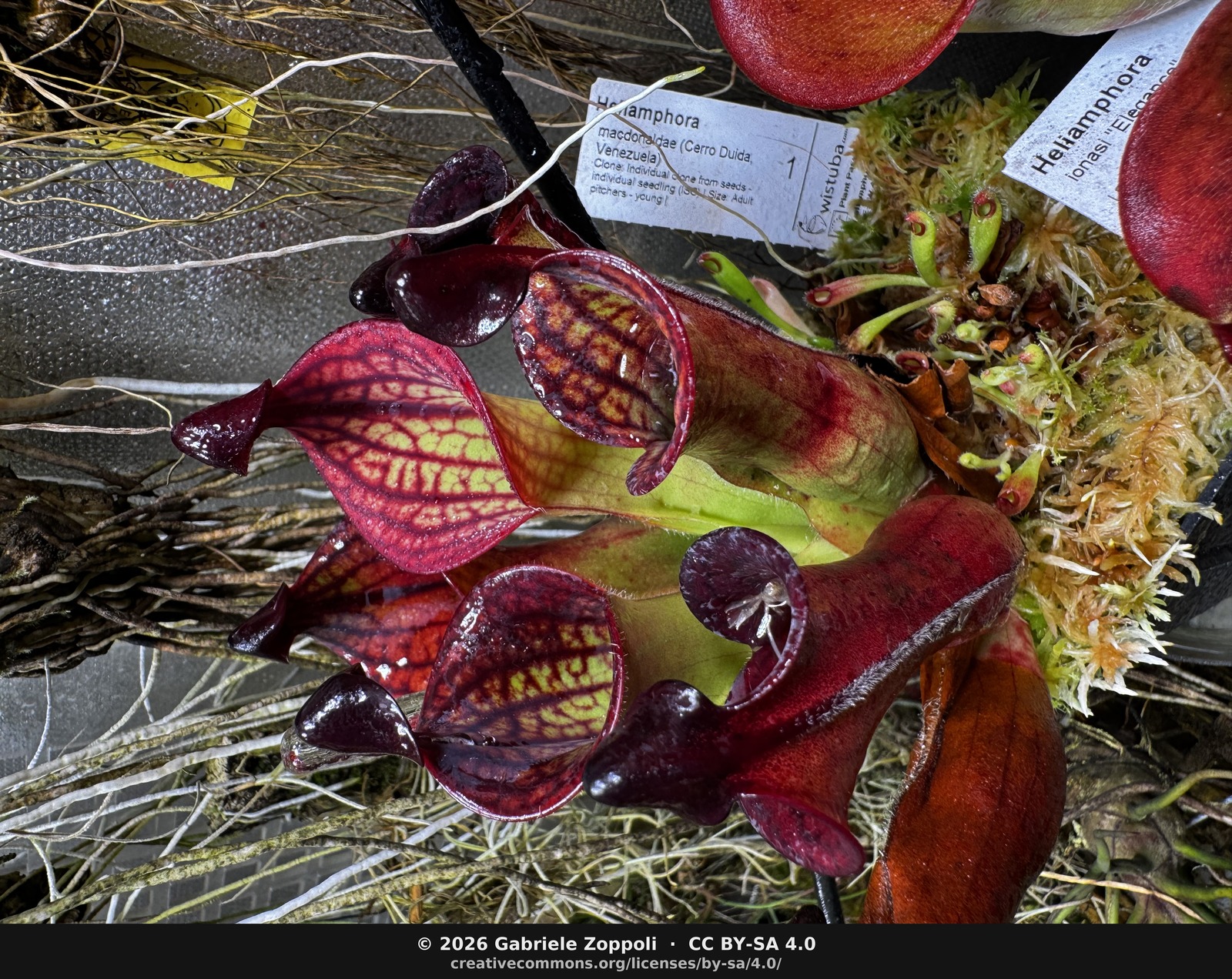
The mysterious Mrs Macdonald
The species name encodes one fact and hides another.
The fact: the genitive ending -ae is feminine. The eponym is a woman — Mrs, Miss, or Ms Macdonald. If Gleason had been honouring a man the species would be macdonaldii. Latin botanical orthography also collapses the English spellings McDonald, MacDonald and Macdonald into the same form, so the surname could carry any of them.
The hidden part: who she was.
Gleason’s 1931 protologue gives no etymology — just the diagnosis.4 The expedition’s personnel list (above) is short and specific: no Macdonald among them. The Torrey Botanical Club’s introduction to the volume thanks “the support of numerous members and friends who have contributed to the special publishing fund” — but names none.4 The two other Cerro Duida species in the same paper, tyleri and tatei, both honour expedition men named on the same page; macdonaldae is the odd one out.
The most plausible scenarios: a donor to the Torrey publishing fund who is named in the Club’s treasurer records but not in the paper itself; a benefactress of the AMNH expedition whose contribution went through a different ledger; or a relative of one of Tate, Deck or Hitchcock whose biography hasn’t been digitised. The Tyler family genealogy I could find — Sidney F. Tyler Sr. (1850–1935) married Mary Woodrow Binney and then Ida Amelia Elkins; Tyler Jr.’s mother was Stella Elkins — contains no Macdonald.
Two archives could resolve this:
- The type specimen of H. macdonaldae is at the New York Botanical Garden’s Steere Herbarium, where Gleason worked.4 The label may carry an etymology note in his hand.
- The Torrey Botanical Society Records at the NYBG Mertz Library include a “Cash ledger 1926–33” (Series 9, folder 36.7) that should itemise the publishing fund’s contributors for the years around Gleason’s paper.11
I’ve sent reference inquiries to both libraries and to the AMNH Museum Archives, which holds the Tyler-Duida Expedition records and Tate’s expedition diary. Two-week response times are normal.
More to follow…
Update — NYBG, May 2026
Stephen Sinon, William B. O’Connor Curator of Special Collections at the NYBG Mertz Library, replied within five days, with two findings: a scan of the type sheet, and a search through the 1931 Torrey ledger.
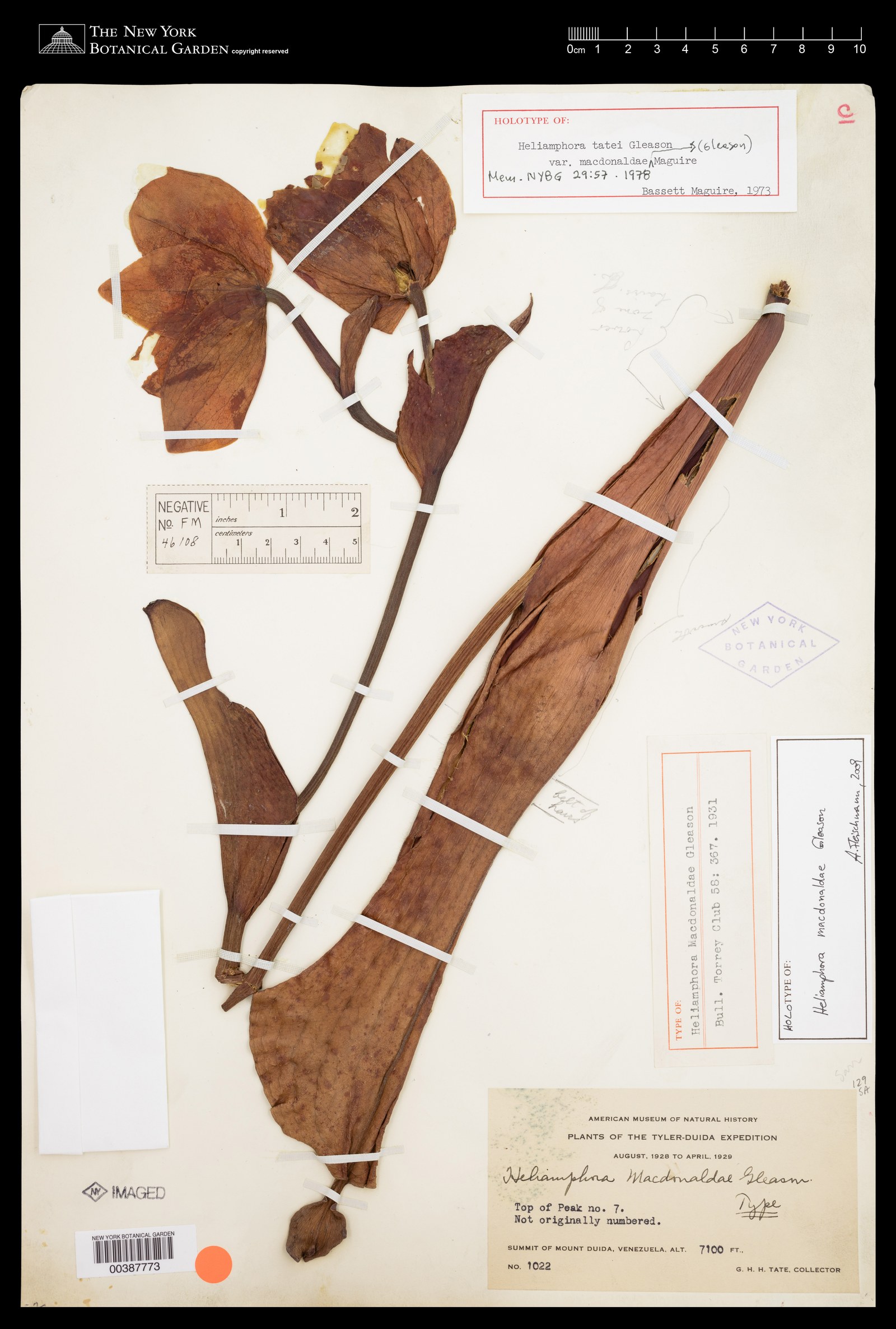
The type sheet. The holotype of Heliamphora macdonaldae is NY barcode 00387773 — Tate’s 1928 collection from “Top of Peak no. 7”, Summit of Mount Duida, Venezuela, 7100 ft, Tate no. 1022.12 Three labels are mounted on the sheet:
- the field label of the Tyler–Duida Expedition, in pencil hand: “Heliamphora Macdonaldae Gleason / Top of Peak no. 7. / Not originally numbered. / Type” — no etymology note;
- Gleason’s determination label, orange-bordered: “TYPE OF / Heliamphora Macdonaldae Gleason / Bull. Torrey Club 58: 367. 1931”;
- and Bassett Maguire’s 1973 annotation, red-bordered, reducing it to H. tatei (Gleason) var. macdonaldae Maguire — the change he later formalised in Mem. NYBG 29: 57 (1978).
The sheet carries no marginal note in Gleason’s hand explaining who the eponym was. Apparently he didn’t write etymology notes on his type sheets.
The Torrey ledger. Sinon also went through the Torrey Botanical Club’s 1931 cash ledger looking for any donor named McDonald, MacDonald or Macdonald to the special publishing fund that Gleason mentions in his introduction. There wasn’t one. The only entry he found earmarked to Gleason’s Bulletins 1931 was Fleda Griffith — $10; Miss Griffith was the Garden’s staff photographer. A handful of Mc and Mac names appeared elsewhere in the book, but only as ordinary club members paying the $5 yearly dues — not as contributors to the publishing fund.13
So neither line at NYBG produces a name: not the publishing-fund ledger, not the type sheet itself. What’s left is the AMNH Museum Archives, which holds Tate’s expedition diary, the Tyler family correspondence, and the financial records of the expedition itself. That inquiry is still open.
Quoted with kind permission of Stephen Sinon, NYBG.
Links
- POWO entry — H. tatei (treats macdonaldae as synonym).
- POWO entry — H. macdonaldae (synonym record).
- Wistuba — Cerro Duida stock.
- Wikipedia — H. macdonaldae.
- Gleason 1931 — Botanical Results of the Tyler–Duida Expedition (Internet Archive).
- NYBG Archives finding aid — Torrey Botanical Society Records.
- McPherson, Wistuba, Fleischmann & Nerz (2011). Sarraceniaceae of South America. Redfern Natural History Productions.
Species of the week is a rolling series. Past entries under the species-of-the-week tag; per-species page with provenance + photos at /collection/species/heliamphora-macdonaldae-cerro-duida-isc/.
Wistuba, A. Heliamphora macdonaldae (Cerro Duida, Venezuela). https://wistuba.com/Heliamphora-macdonaldae-Cerro-Duida-Venezuela/AW-H-mcd.2 (accessed 2026-04-28). ↩︎ ↩︎ ↩︎
Museikautas. Heliamphora macdonaldae — The Forgotten Marsh Pitcher Plant. https://www.musekautas.lt/?p=4959. ↩︎
International Carnivorous Plant Society — Heliamphora genus overview. https://www.carnivorousplants.org. ↩︎
Gleason, H.A. (1931). Botanical Results of the Tyler-Duida Expedition. Bulletin of the Torrey Botanical Club 58 (5): 277–344; (6): 345–404. Tate’s expedition narrative is embedded as Section II. Heliamphora macdonaldae sp. nov. is described on p. 367. Full text via Internet Archive: https://archive.org/details/sim_journal-of-the-torrey-botanical-society_1931-05_58_5. ↩︎ ↩︎ ↩︎ ↩︎ ↩︎ ↩︎ ↩︎
Wikipedia. Cerro Duida. https://en.wikipedia.org/wiki/Cerro_Duida (accessed 2026-04-28). ↩︎
Wikipedia. Tepui. https://en.wikipedia.org/wiki/Tepui. ↩︎
Plants of the World Online. Heliamphora tatei Gleason, Bull. Torrey Bot. Club 58: 368 (1931); Heliamphora macdonaldae Gleason, Bull. Torrey Bot. Club 58: 367 (1931). https://powo.science.kew.org/taxon/urn:lsid:ipni.org:names:118880-2. ↩︎ ↩︎
McPherson, S., Wistuba, A., Fleischmann, A. & Nerz, J. (2011). Sarraceniaceae of South America. Redfern Natural History Productions, Poole. ISBN 978-0-9558918-7-8. ↩︎
Wikipedia. Heliamphora macdonaldae. https://en.wikipedia.org/wiki/Heliamphora_macdonaldae (accessed 2026-04-28). ↩︎
Wikipedia. Andreas Wistuba. https://en.wikipedia.org/wiki/Andreas_Wistuba. ↩︎
NYBG Mertz Library Archives. Torrey Botanical Society Records, Series 9 (Financial), folder 36.7 “Cash ledger 1926-33”. Finding aid at https://nybgarchives.libraryhost.com/. ↩︎
NYBG Steere Herbarium, holotype barcode NY00387773, Heliamphora macdonaldae Gleason. Public record at https://sweetgum.nybg.org/science/vh/specimen-details/?irn=234875 (the page shows two scan thumbnails of the same sheet — a Memoir-129 published version and the 2017 Canon EOS 5DS R full-resolution scan). Full-res image via GBIF (CC BY 4.0): http://sweetgum.nybg.org/images3/2232/088/00387773.jpg; thumbnail: http://sweetgum.nybg.org/images3/30/257/v-129-00387773.jpg. GBIF occurrence key 1928790480. ↩︎
Stephen Sinon, William B. O’Connor Curator of Special Collections, Research and Archives, NYBG Mertz Library — personal communication, 5–6 May 2026 (via NYBG Mertz Library Archives ticket #18220094). Finding from Torrey Botanical Society Records, Series 9 (Financial), 1931 ledger. ↩︎
Comments
Thoughts, corrections, trade offers welcome. Comments live on GitHub Discussions; sign in with a GitHub account to post.