Species of the week: Neofinetia falcata 'Akausagi' (赤兎)
A triple-spur Japanese fukiran selection — pinkish-red flowers, upper spurs branching like rabbit ears. Lives year-round on the Genoa balcony, in filtered sun.
赤兎 — red rabbit. The flowers are pinkish-red. The spurs come in threes, and the upper two curl upward like rabbit ears. The cultivar name is literal.
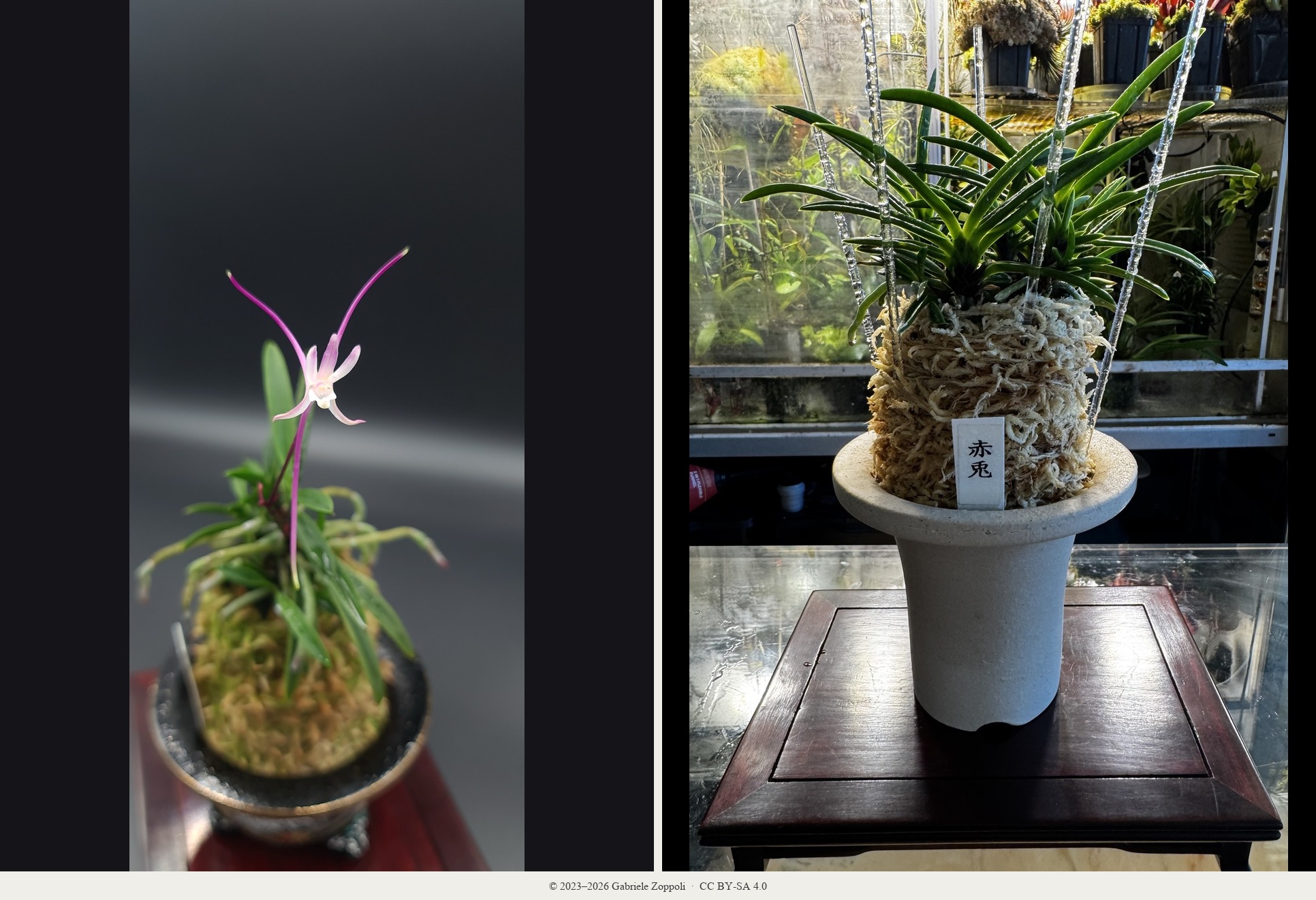
The triple spur
A normal Vanda falcata flower is about 3 cm across, white, fragrant at night, with one long curved spur of ~3.7 cm trailing behind.1 ‘Akausagi’ has three spurs: the trailing one plus two more curling upward from the column. The three come every year, not just occasionally — the reason this clone is the one fukiran growers ask for by name.2
It came out of Syutennou (酒呑童子) seedlings. Propagated only by division — hence the rarity and the price.2
The name
- Genus Neofinetia — H. H. Hu, 1925. Honors Achille Eugène Finet (1863–1913), a French botanist of Japanese and Chinese orchids. “Neo-” because an earlier genus Finetia already had the name.3
- falcata — Latin sickle-shaped, after the leaves.
- ‘Akausagi’ (赤兎) — Japanese for “red rabbit”. The same characters as Lü Bu’s legendary “Red Hare” horse from the Three Kingdoms — coincidental reuse of a stock “colour + animal” compound, not a reference.2
- Vanda falcata — Gardiner sank Neofinetia into Vanda in 2012 (Phytotaxa 61).4 Most fukiran growers and Japanese societies still use Neofinetia; Kew and POWO use Vanda.
Where it’s from
Japan (Kyushu, Honshu, Shikoku, Yakushima, Tanegashima, Okinawa), South Korea, central China. Epiphyte on tree bark, lithophyte on rock; mid-elevation forests, dappled shade.1 Carl Peter Thunberg collected the type on the hills above Nagasaki in the mid-1770s; published it as Orchis falcata in Flora Japonica (Uppsala, 1784).3
How mine got here
Negie Orchids (Kiyoshige Negi), Japan, November 2020.5 Arrived near blooming size, several keikis already at the base. First flower the following spring — one inflorescence, three spurs (left panel of the hero). Repotted in spring 2025 into a white Japanese fukiran pot, moss-mound planting, calligraphy tag (right panel).
The single most expensive plant in the collection.
Growing it
Year-round on the Genoa balcony, filtered sun under light shade. The Mediterranean winter (overnight lows ~5 °C, daytime 10–14 °C) sits inside the 3–13 °C winter range AOS and Travaldo report for the species.61 Summer days 25–32 °C, cooler at night from the sea breeze — close to the 26–31 °C / 19–23 °C envelope cited for habitat.1
- Filtered light. Direct mid-summer Mediterranean sun burns the leaves.
- Heavy water in growth, dry between waterings. V. falcata runs CAM photosynthesis. The usual failure is root rot.6
- Long-fibre sphagnum in the traditional kokedama mound — tight at the core, looser at the surface.
- Outdoors year-round. Tolerates short dips toward 0 °C. Lives outside the highland cabinet — open-air day-length and temperature swings suit it better.
Notes
- Pollination — nocturnal fragrance, long spur, white flower: a hawkmoth-pollination syndrome. Suetsugu, Tanaka, Okuyama & Yukawa (2015) recorded Theretra japonica and T. nessus probing the spurs of wild-type plants.7 Whether moths handle ‘Akausagi’ the same way is an open question — the cultivar sets seed by hand-pollination, and the triple-spur character is decorative, selected by eye.
- Fukiran (富貴蘭) — “orchid of wealth and rank”. V. falcata has been cultivated in China since the late Ming and in Japan at least since the Kanbun era (1661–1673). Edo-period tradition restricted the prized cultivars to the samurai and daimyō class; AOS reports that a specimen presented to a shogun could earn the giver an estate.6 The All Nippon Fuukiran Orchid Society now lists over 2,200 selected varieties, around 200 on its annual Meikan ranking.6
Links
- POWO — Vanda falcata — accepted name, authority, distribution.
- AOS — Neofinetia falcata — cultivation overview and fukiran context.
- Travaldo — Neofinetia falcata care and culture — temperature, light, humidity targets.
- Negie Orchids — ‘Akausagi’ listing — source nursery; description of the triple-spur trait and Syutennou parentage.
- Suetsugu et al. (2015). European Journal of Entomology 112(2): 393–397 — hawkmoth pollination, DOI 10.14411/eje.2015.031.
Species of the week is a rolling series. Past entries under the species-of-the-week tag; per-species page with provenance + photos at /collection/species/neofinetia-falcata-akausagi-赤兎/.
Travaldo’s Blog — Neofinetia falcata care and culture (2018). Flower ~3 cm with 3.7 cm curved spur; nocturnal fragrance; native to Kyushu, Honshu, Shikoku, Yakushima, Tanegashima, Okinawa, South Korea, central China; type locality Nagasaki. ↩︎ ↩︎ ↩︎ ↩︎
Negie Orchids — Neofinetia falcata ‘Akausagi’ listing. Selected from Syutennou seedlings; red flowers with three spurs each year; upper two spurs branch like rabbit ears. ↩︎ ↩︎ ↩︎
Wikipedia — Vanda falcata. Genus Neofinetia erected by H. H. Hu, 1925, honoring Achille Finet (1863–1913); basionym Orchis falcata Thunb., Flora Japonica, Uppsala, 1784. ↩︎ ↩︎
Gardiner, L.M. (2012). New combinations in the genus Vanda (Orchidaceae). Phytotaxa 61: 47–54. ↩︎
Personal inventory record; Negie Orchids, Japan; order #0148, November 2020; near blooming size with multiple keikis, EMS-shipped with CITES and phytosanitary certificate. ↩︎
American Orchid Society — Neofinetia falcata species page. CAM photosynthesis; tolerance from near-freezing to ~35 °C; Edo-period samurai cultivation; >2,200 registered varieties; ~200 on the All Nippon Fuukiran Orchid Society Meikan annual ranking. ↩︎ ↩︎ ↩︎ ↩︎
Suetsugu, K., Tanaka, K., Okuyama, Y. & Yukawa, T. (2015). Potential pollinator of Vanda falcata (Orchidaceae): Theretra (Lepidoptera: Sphingidae) hawkmoths are visitors of long spurred orchid. European Journal of Entomology 112(2): 393–397. ↩︎
Comments
Thoughts, corrections, trade offers welcome. Comments live on GitHub Discussions; sign in with a GitHub account to post.