Species of the week: Utricularia quelchii
A red-flowered tepui bladderwort from sect. Orchidioides — the orchid-mimic celebrities of the genus. Named for J. J. Quelch, who climbed Roraima in 1898.
Utricularia quelchii is one of a small number of strongly red-flowered bladderworts. U. quelchii and U. campbelliana are Pantepui species, on wet rock and in moss banks across the Guiana Highlands. U. menziesii is unrelated — south-western Australia, in subgenus Polypompholyx (sect. Pleiochasia) — and arrived at the same colour independently.1 Three years vegetative growth in my cabinet, and as of last week the first flower is open — a diaristic note went up under that title; this post is the encyclopaedic counterpart.
The name
Utricularia — Latin utriculus, “little bag”, for the suction trap. The species epithet honours John Joseph Quelch (b. 1854), Curator of the Museum of British Guiana, formerly of the British Museum’s zoological department; a naturalist with strong ornithological interests.2 Quelch and F. V. McConnell (the colony’s government geologist) climbed Mount Roraima twice, in 1894 and 1898, following Everard im Thurn’s 1884 first ascent. The species’ type — Quelch & McConnell 105, holotype Kew — is the 1894 summit collection.3 N. E. Brown worked the material up at Kew and published it in the Transactions of the Linnean Society of London in 1901, alongside the rest of the McConnell–Quelch botany.4
Where it’s from
Utricularia quelchii N.E.Br., Trans. Linn. Soc. London, Bot. 6: 53 (1901).5 Distribution scattered across the Guiana Highlands: Guyana, southern Venezuela (Bolívar tepuis including Roraima, Ilu, Auyán, Chimantá; plus Amazonas outliers Cerro de la Neblina and Cerro Huachamacari), and northern Brazil at Neblina’s southern slope. Cerro de la Neblina (on the Venezuela–Brazil border) marks the southwestern outpost of the range.5 Habitat: wet mossy banks, peaty rock faces, occasionally tree trunks, and the leaf axils of Brocchinia — not just summit bogs.1 Elevation 1,400–2,800 m, typically around 2,000 m.6 Lifeform: tuberous lithophyte or epiphyte.5 Subgenus Utricularia, section Orchidioides (Taylor 1989).6
There is one homotypic synonym worth noting — Orchyllium quelchii (N.E.Br.) Gleason, Bull. Torrey Bot. Club 56: 405 (1929) — from the same Gleason who described Heliamphora macdonaldae two years later. The split-off generic name didn’t catch on, and POWO keeps the species in Utricularia.5
My label says “Ilu Tepui”. That places it on the Ilu–Tramen massif, the northernmost member of the Eastern Tepuis chain, in Bolívar state.
The two summits visible in the centre of the satellite frame are Ilu (south, 2,700 m) and Tramen (north). Karaurín-tepui is just to the south.7 (Open in Google Maps)
Section Orchidioides
Barry Rice’s frame is the one to borrow:
“The plants in section Orchidioides are the celebrities of the genus Utricularia … large leaves or spectacular flowers … sometimes called the ‘orchid-flowering’ or ’epiphytic’ Utricularia.”1
In Taylor’s strict 1989 sense the section had nine species; later phylogenetic work folded the former sect. Iperua into an expanded Orchidioides, taking the count to roughly 15–16 species.8 Almost entirely Neotropical, concentrated in two zones: the northern Andes cloud forest belt (most species) and the Pantepui (a handful, including quelchii, campbelliana, and — under the expanded treatment — humboldtii). Most are epiphytes or lithophytes on permanently wet rock, sometimes in the leaf axils of Brocchinia — Rice notes this for quelchii specifically.1 The flowers mimic orchid corollas closely enough that early collectors filed the section under Orchidaceae before the bladders gave them away.
Trap mechanism, briefly
Every Utricularia uses the same trap: a hollow bladder with a hinged door at one end. The plant pumps water out from the inside, the walls cave inwards under the strain, and a trip hair on the door waits.
“The bladder walls are flexible, but at rest bulge outwards like an overstuffed pita bread sandwich … when the creatures bump into the hairs near one end of the bladder, they initiate something marvelous. A trap door opens at the end of the bladder, and water is allowed to rush into the bladder.”9
In studied aquatic Utricularia (e.g. U. inflata, U. vulgaris, U. australis), high-speed video records the door opening and water rushing in within 0.3–0.7 ms — among the fastest movements in the plant kingdom.10 No species-specific timing has been published for U. quelchii; the trap is presumed to operate the same way. Prey are micro-crustaceans, ciliates, rotifers; the plant digests via bacterial commensals plus its own enzymes.9
The traps in epiphytic Orchidioides are smaller and harder to see than in aquatic species — they sit on stolons buried in the Sphagnum and feed on whatever the moss-bog microfauna provides.
How it got here
Carnivors & More (Christian and Claudia Klein, Germany), early 2023, label Utricularia quelchii, Ilu Tepui. A handful of teardrop leaves on live Sphagnum, a few traps already visible, and three years of nothing-but-leaves before last week’s spike.
Growing it
- 12–22 °C, day/night drop of 4–6 °C. The cabinet runs a Chinchiná, Colombia profile (4.98 °N, ~1,300 m, 13.5–24.3 °C / 75–98 % RH) — a degree or two warmer than the Ilu summit but inside the published 1,400–2,800 m envelope for the species.6
- Live Sphagnum only, in a 10 cm perforated terracotta pot. The moss has overflowed and reads as a kokedama.
- Hung on the left side of the highland cabinet, mid-height, directly under one of the misters. The position matters: it sits in the path of the lateral airflow loop, so the Sphagnum is permanently saturated but never anoxic — the moss stays oxygenated by air movement, not by drying out between cycles. No manual watering; water is the cabinet’s RO line.
- Intermediate-high light. The Heliamphora sit about 30 cm from the LED array (the full-sun tier); quelchii is a step below that, mid-cabinet, with no shade above it.
- No fertiliser. Akerne Orchid Mix at half a teaspoon per three litres goes on the orchids next to it as foliar a couple of times a month; the quelchii picks up the spillover.
This departs from Barry Rice’s recommendation — Rice prefers a Sphagnum+perlite mix kept “a little drier than you are used to with carnivorous plants”, watered from above only, and warns that tray watering is harmful.11 My substrate is closer to permanently saturated than to “a little drier”. The reason it works here, I think, is the airflow: continuous air movement keeps the live Sphagnum oxygenated even while it stays wet. Rice’s recipe is the conservative starting point — perlite + drier dosing forgive a still-air setup. Mine is what fell out of putting the plant under a mister, in moving air, and not touching it for three years.
Pink, red, or both?
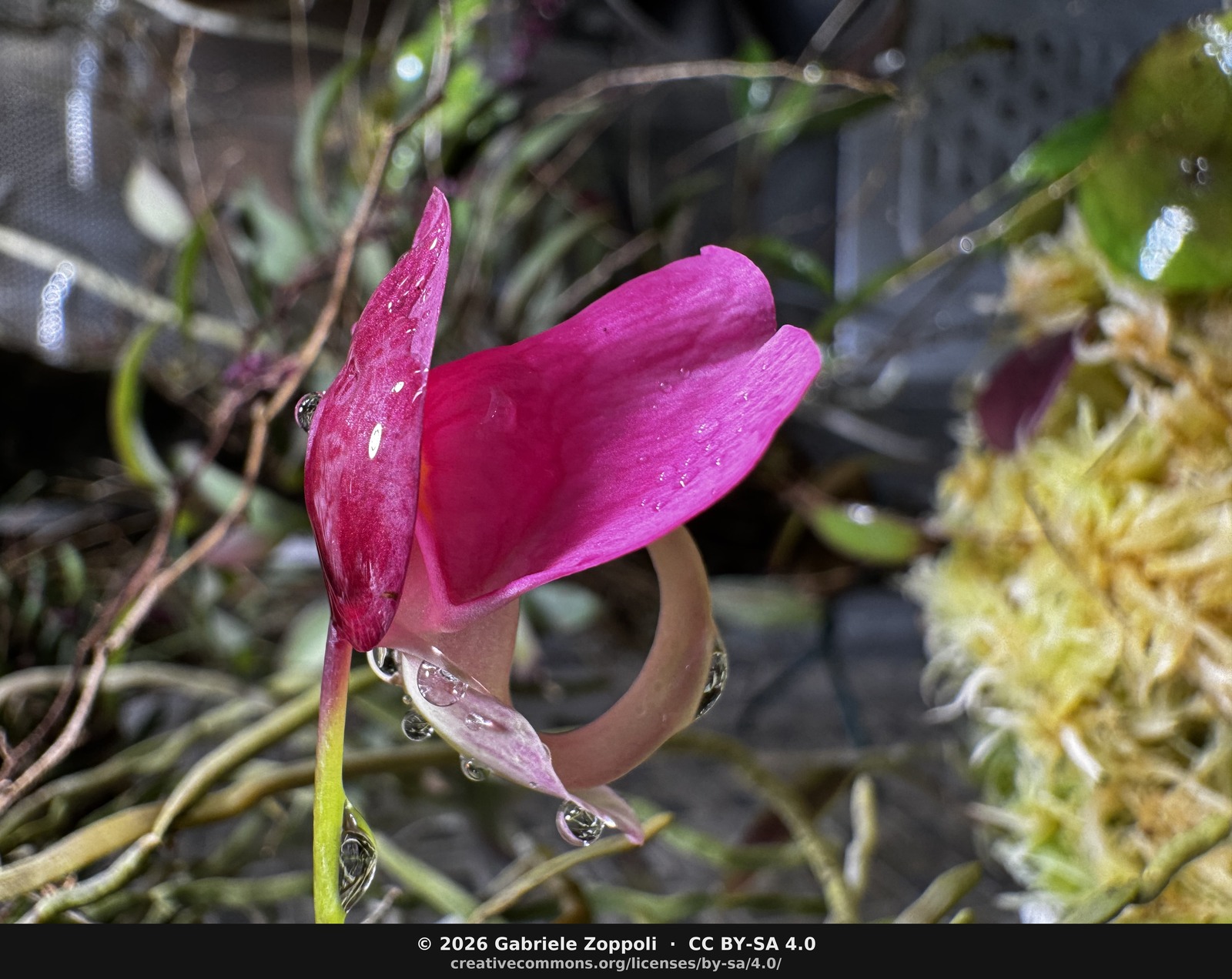
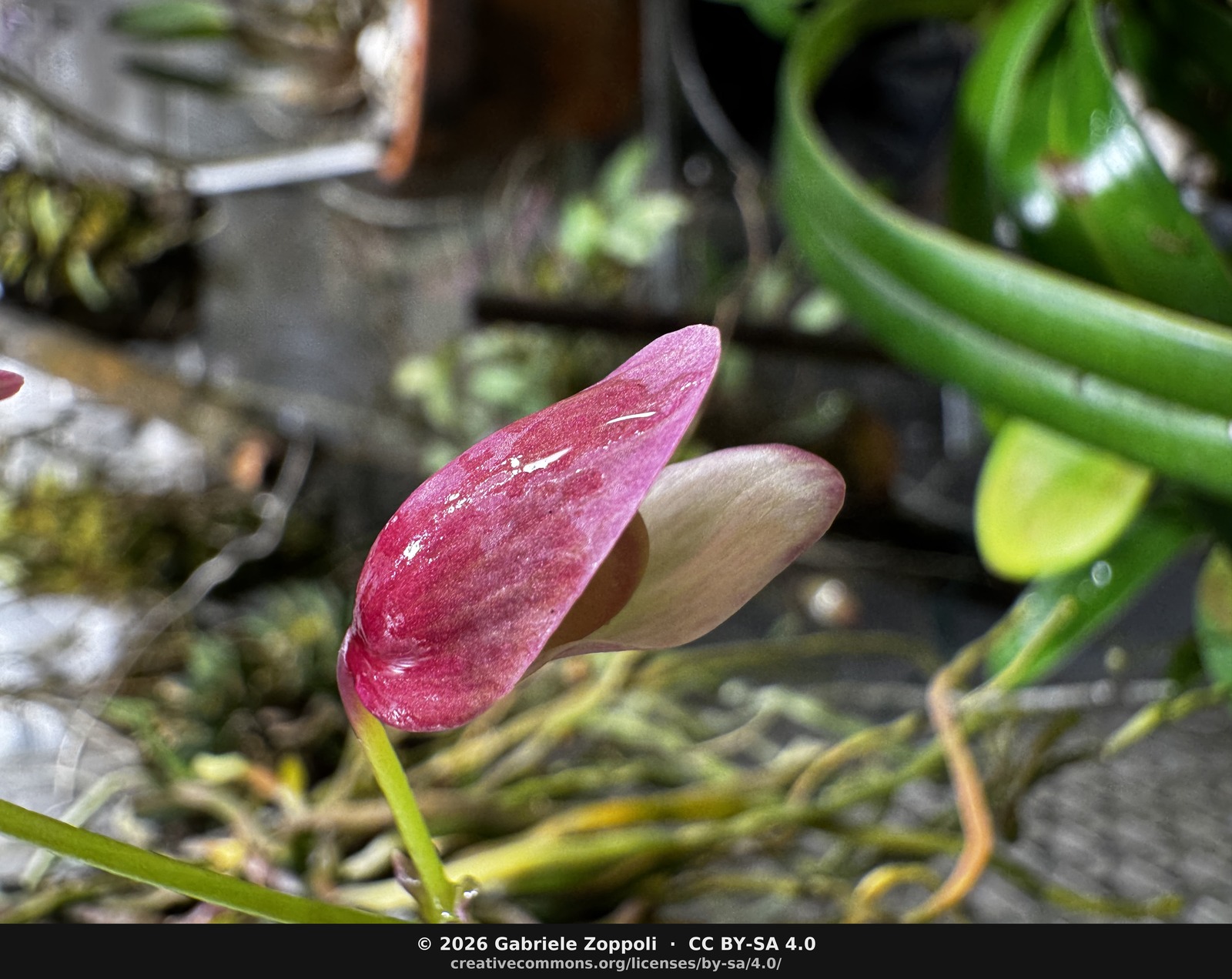
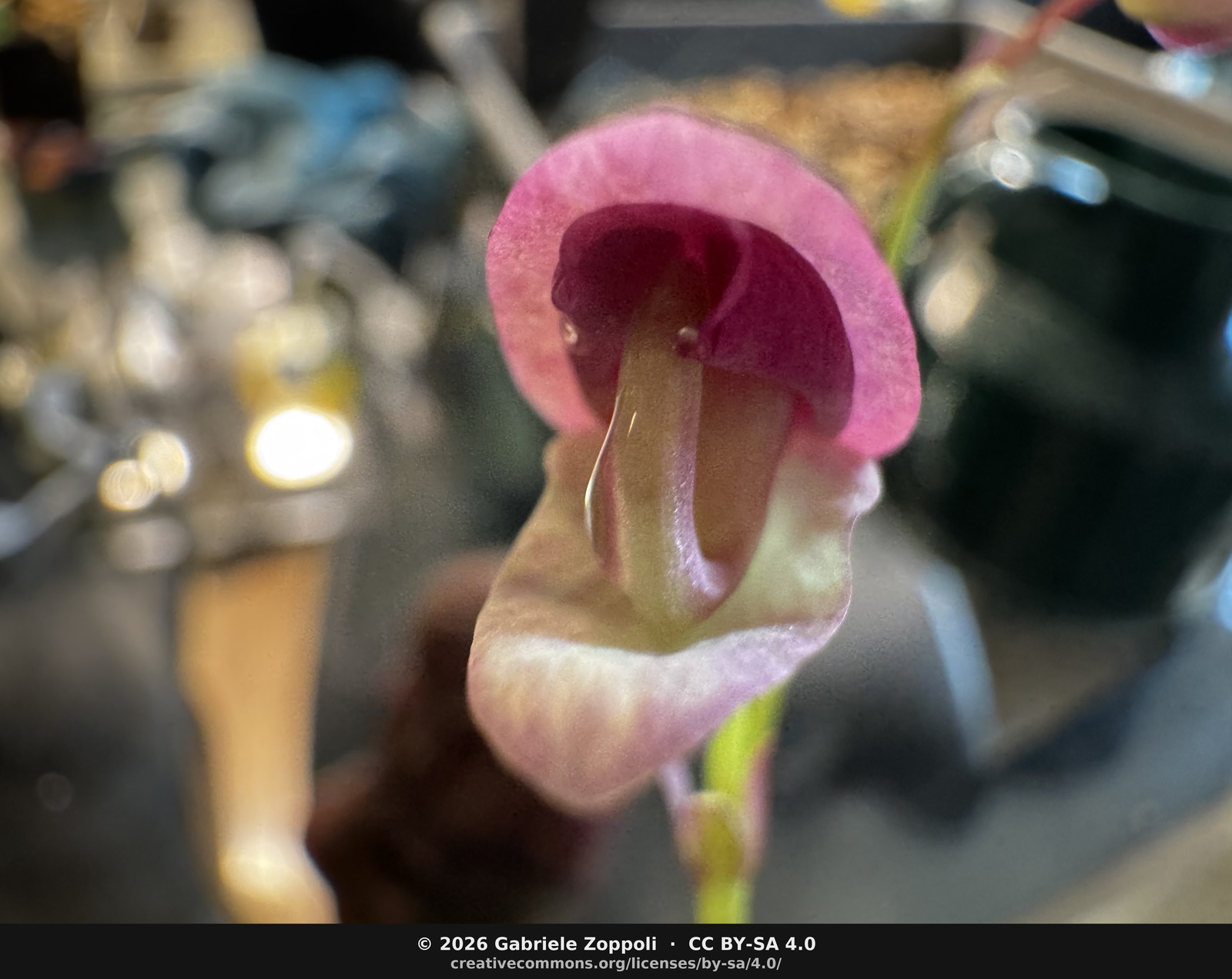
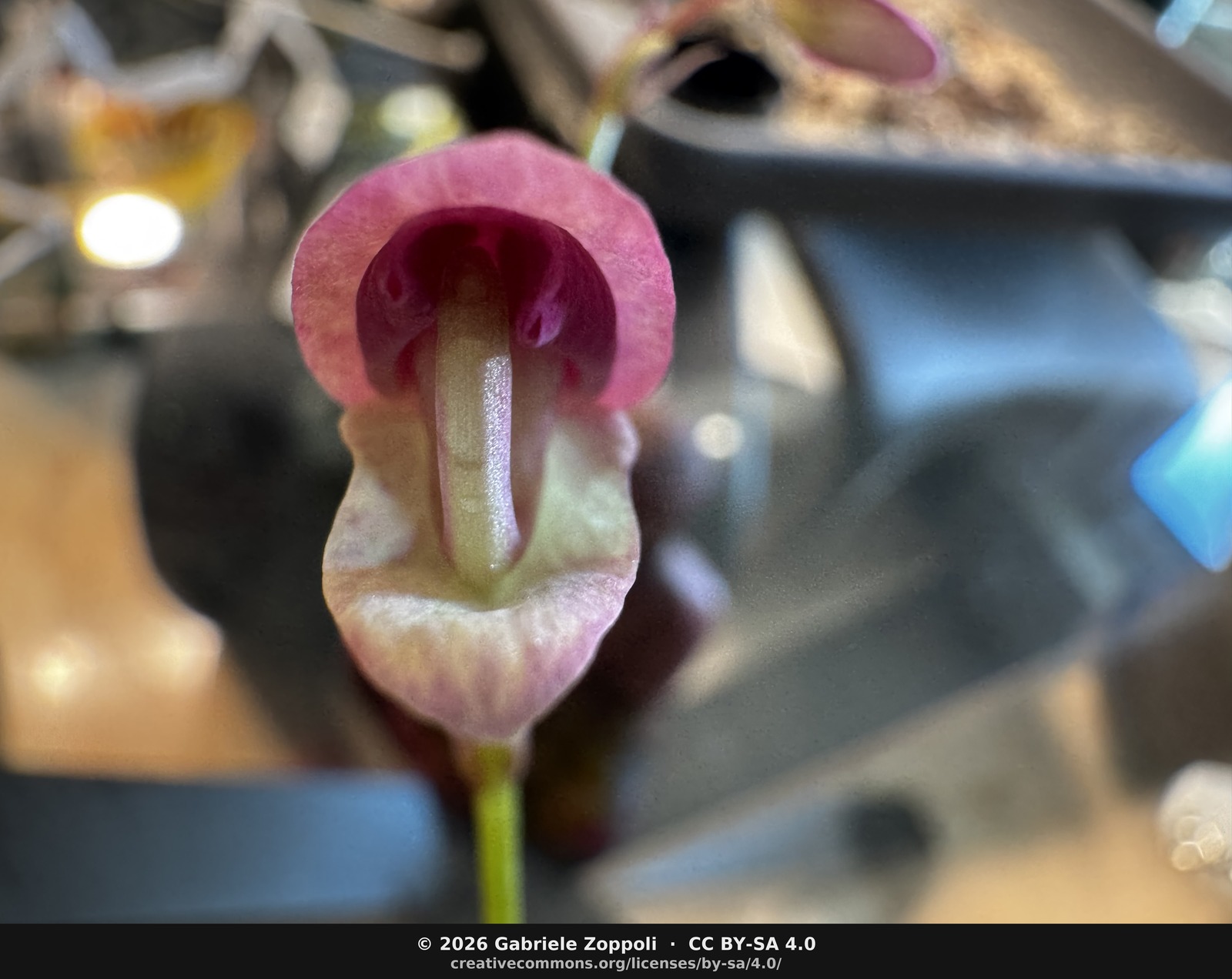
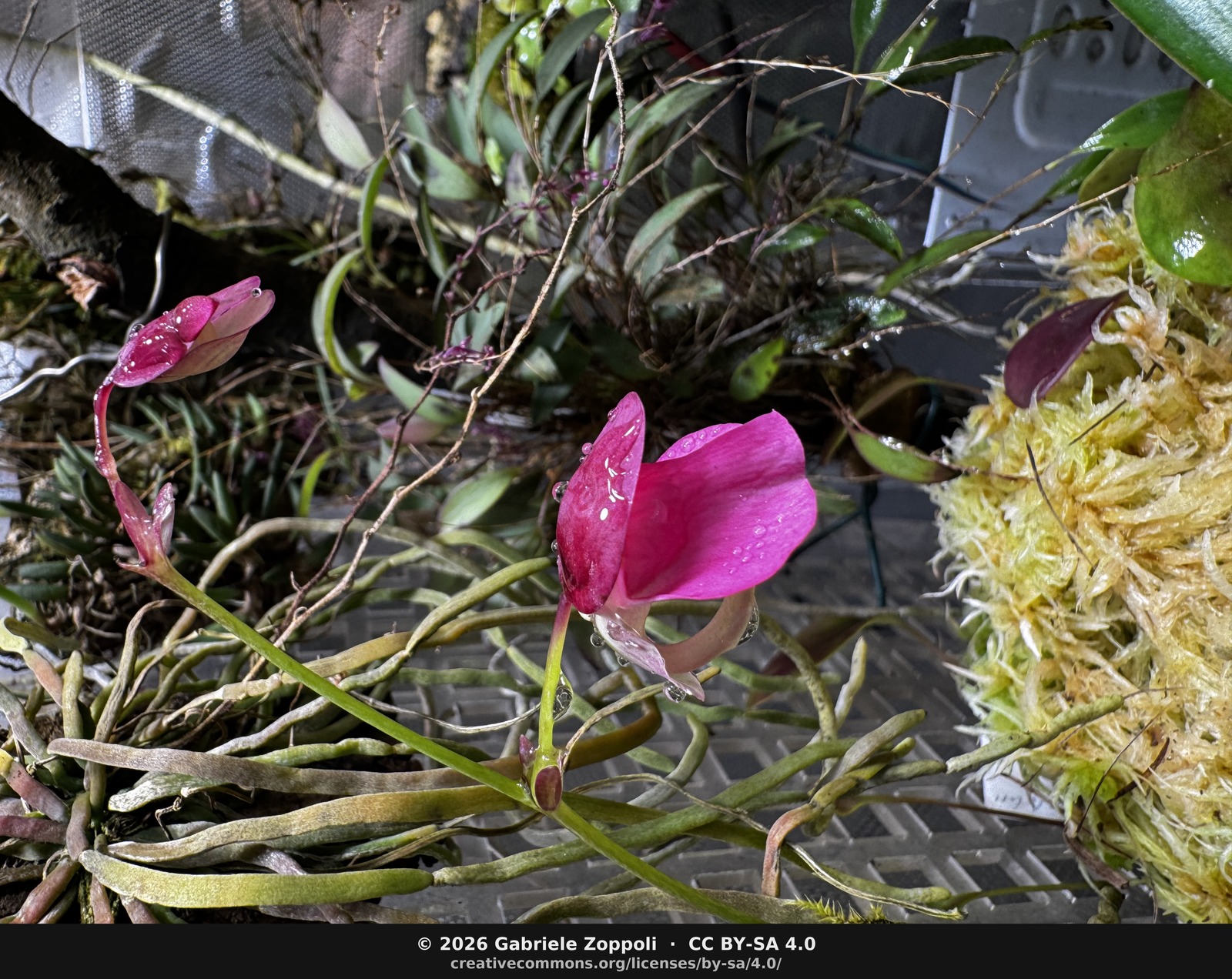
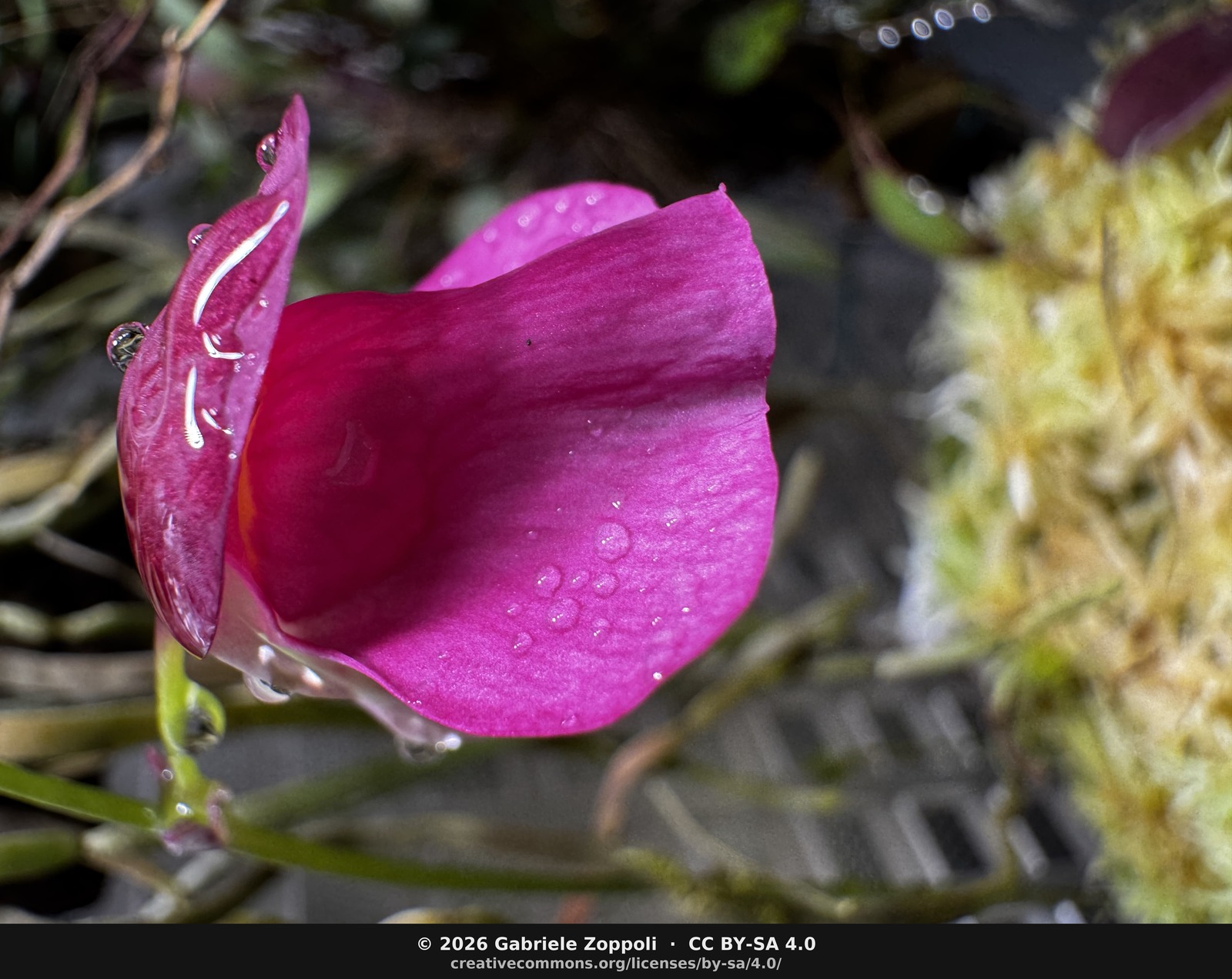
Mine is magenta — a cool magenta on the galea, fading to white-pink on the lower lip — not the blood-red advertised by many vendors and depicted in some habitat photos. Worth pulling on this thread, because “red-flowered” turns out to be a generic-bin description and the species shows real intraspecific colour variation.
The reference cultivators publish “red”, full stop. Barry Rice writes that quelchii “shares with U. campbelliana and U. menziesii the distinction of being a red-flowered Utricularia” — no clone-level granularity.1 Vendor copy goes anywhere from “fantastic red flowers”12 to “amazing pink red flowers” to “pink to deep red”.
The most informative source I’ve found is in-habitat photography from Mt. Roraima itself. An D Smith documented colour variation directly on the summit and posted the run on the CPUK forum: pink, pink-with-red-centre, red-and-pink, orange-red-and-pink, and pure red.13 The key observation:
“The only red-flowered forms of U. quelchii were seen on Roraima.” Plants on other tepuis showed pink, with longer flower stalks and multiple flowers per scape.13
That matches my plant. It’s labelled Ilu Tepui — different summit, expected pink-to-magenta colour, two-flower scape (both buds open as of mid-May; see update at the end of the post). The “blood red” plants in catalogues are Roraima provenances; vendors that don’t differentiate by tepui are probably mixing the two.
Why does Roraima carry red? Smith and the CPUK regulars float the hybrid hypothesis: U. campbelliana — the other red-flowered Pantepui Utricularia — grows alongside quelchii on Roraima but not (or rarely) on the other tepuis.13 Two saturated-red, hummingbird-attracting flowers in the same square metre is the kind of setup that produces hybrid swarms. No molecular study has confirmed this yet (none I could find), so it stays a working hypothesis. But it’s a clean explanation for why the deep-red phenotype clusters at the type locality.
So when I say “red-flowered species” in the previous sections, the precise reading is: quelchii belongs to the small handful of pigmented bladderworts pulling toward the long-wavelength end, with substantial intraspecific spread from pink (Ilu, Auyán, etc.) through magenta (mine) to red (Roraima — possibly with introgression). Without molecular work the boundaries stay fuzzy.
Curios
Red flowers in the genus. A small set: U. quelchii (Pantepui), U. campbelliana (Pantepui), U. menziesii (south-western Australia, unrelated section, colour evolved independently), and a few less-saturated reds like U. reniformis.1 U. campbelliana has documented hummingbird visitation; U. menziesii is visited by Western Spinebill (Acanthorhynchus superciliosus); U. quelchii’s pollinator is not yet documented in the literature I could find. Inferred bird-pollination convergence across two unrelated lineages, but the data are thin.14
Lives in Brocchinia. Rice notes quelchii “often grows in the leaf axils of Brocchinia”1 — the giant tank bromeliads of the Pantepui, themselves carnivorous (per Givnish 1984 for B. reducta). The bladderwort hangs out in the rosette tank, draws nutrients from prey trapped by both itself and its host, and benefits from the moisture buffer the bromeliad maintains.
Tuberous. Several Orchidioides species, including quelchii, store water in subterranean tubers and survive mild dry periods that other epiphytic Utricularia don’t tolerate.1 In cultivation this rarely matters; under permanent mist the tubers stay small and the plant runs on stolons.
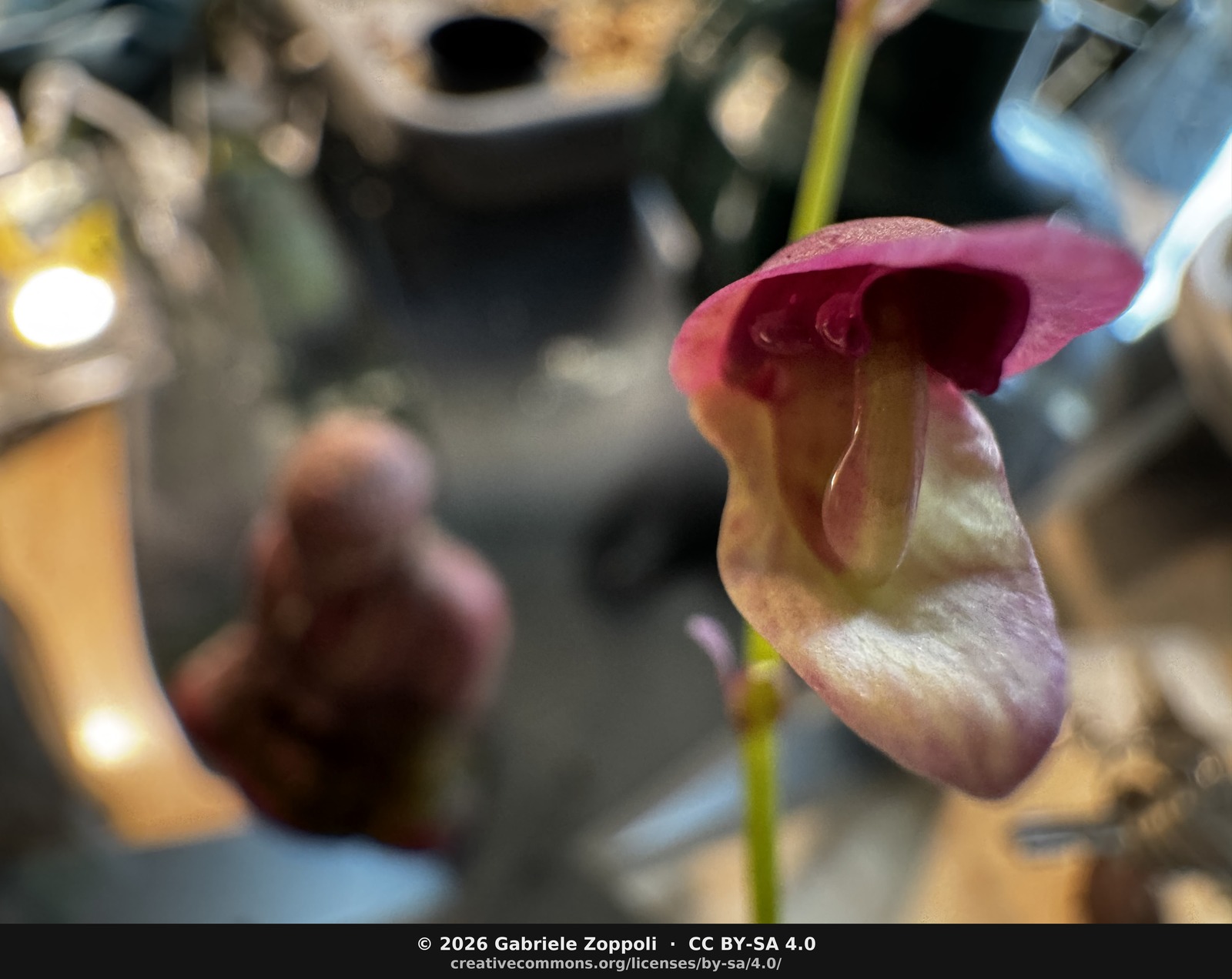
Update — 2026-05-11
The second bud has opened, four days after the first. Both flowers face out from the same scape, magenta hood and pink lower lip on each — the two-flower display the colour-variation literature attaches to non-Roraima provenances.
Links
- POWO — Utricularia quelchii.
- Wikipedia — Utricularia quelchii.
- Brown 1901 — Botanical results of the McConnell–Quelch Roraima expedition.
- Sarracenia.com — Section Orchidioides (FAQ 5656).
- Sarracenia.com — Epiphytic Utricularia (FAQ 5592).
- Sarracenia.com — Bladder trap mechanism (FAQ 1345).
- First-bloom diary — U. quelchii, three years in.
- Taylor, P. (1989). The Genus Utricularia — A Taxonomic Monograph. Kew Bulletin Additional Series XIV.
Species of the week is a rolling series. Past entries under the species-of-the-week tag; per-species page with provenance + photos at /collection/species/utricularia-quelchii/.
Rice, B. The Carnivorous Plant FAQ — Section Orchidioides (FAQ 5656). https://www.sarracenia.com/faq/faq5656.html (accessed 2026-05-07). All quoted phrases (“celebrities of the genus”, “orchid-flowering or epiphytic Utricularia”, “often grows in the leaf axils of Brocchinia”, red-flowered species list) are Rice’s wording. ↩︎ ↩︎ ↩︎ ↩︎ ↩︎ ↩︎ ↩︎ ↩︎
Search results indexed by the Biodiversity Heritage Library and Stabroek News (history feature on the British Guiana Museum) — J. J. Quelch (b. 1854), Curator of the British Guiana Museum, naturalist (zoologist with ornithology focus); led the 1894 and 1898 Roraima expeditions with F. V. McConnell. https://www.biodiversitylibrary.org/part/13205; https://www.stabroeknews.com/2010/03/25/guyana-review/history-timehri-life-history-of-the-journal-of-the-royal-agricultural-commercial-society-of-british-guiana/. ↩︎
NYBG Steere Herbarium isotype, Quelch & McConnell 105, Mt. Roraima, British Guiana, November 1894. The protologue (Brown 1901) cites material from both the 1894 and 1898 ascents, but the type collection is the 1894 one. https://sweetgum.nybg.org/science/vh/specimen-details/?irn=551657 (Cloudflare-gated; mirrored on GBIF). ↩︎
Brown, N. E. (1901). I. Report on two Botanical Collections made by Messrs. F. V. McConnell and J. J. Quelch at Mount Roraima in British Guiana. Trans. Linn. Soc. London. 2nd Series. Bot. 6 (1): 1–107. https://onlinelibrary.wiley.com/doi/abs/10.1111/j.1095-8339.1901.tb00001.x. ↩︎
Plants of the World Online. Utricularia quelchii N.E.Br., Trans. Linn. Soc. London, Bot. 6: 53 (1901). Native range: S. Venezuela to Guyana and Brazil (Cerro de la Neblina). Lifeform: tuberous lithophyte or epiphyte. https://powo.science.kew.org/taxon/urn:lsid:ipni.org:names:260834-2 (accessed 2026-05-07). ↩︎ ↩︎ ↩︎ ↩︎
Wikipedia. Utricularia quelchii. https://en.wikipedia.org/wiki/Utricularia_quelchii (accessed 2026-05-07). Elevation envelope and section assignment cite Taylor 1989. ↩︎ ↩︎ ↩︎
Wikipedia. Ilú–Tramen Massif. https://en.wikipedia.org/wiki/Ilu_Tepui (accessed 2026-05-07). Coordinates 5°24′18″N 61°00′20″W; Ilu summit 2,700 m; Bolívar state, Venezuela; northernmost massif of the Eastern Tepuis. ↩︎
Rodrigues, F. G. et al. (2017). Phylogenetics of Utricularia (Lentibulariaceae) and the expanded sect. Orchidioides: morphology and molecular data place the former sect. Iperua within Orchidioides. Annals of Botany 120 (5): 709–724. https://doi.org/10.1093/aob/mcx088. ↩︎
Rice, B. The Carnivorous Plant FAQ — How does the bladderwort suction trap work? (FAQ 1345). https://www.sarracenia.com/faq/faq1345.html (accessed 2026-05-07). ↩︎ ↩︎
Vincent, O., Weißkopf, C., Poppinga, S., Masselter, T., Speck, T., Joyeux, M., Quilliet, C. & Marmottant, P. (2011). Ultra-fast underwater suction traps. Proceedings of the Royal Society B 278: 2909–2914. https://doi.org/10.1098/rspb.2010.2292. Door-opening and water inrush in aquatic Utricularia timed at 0.3–0.7 ms. ↩︎
Rice, B. The Carnivorous Plant FAQ — Epiphytic and emergent Utricularia (FAQ 5592). https://www.sarracenia.com/faq/faq5592.html (accessed 2026-05-07). Cultivation prescriptions cited (Sphagnum+perlite, “a little drier”, water from above, 16–27 °C, no fertiliser) are Rice’s. ↩︎
Heldros (PL). Utricularia QUELCHII — Ilu Tepui. Vendor product page, accessed 2026-05-07. https://heldros.com/en_US/p/Utricularia-QUELCHII-Ilu-Tepui/177. Vendor description “fantastic red flowers” cited as an example of catalogue copy that doesn’t differentiate provenance. ↩︎
Smith, A. D. and CPUK Forum participants. Flower colour variation of Utricularia quelchii. CPUK Carnivorous Plants forum, “Carnivorous Plants in Habitat” thread. https://www.cpukforum.com/forum/index.php?/topic/32751-flower-colour-variation-of-utricularia-quelchii/. Photographs from Mt. Roraima documenting pink, red-with-pink, orange-red and pure-red phenotypes; observation that red is restricted to Roraima and the discussion of possible U. campbelliana introgression. ↩︎ ↩︎ ↩︎
Płachno, B. J. et al. (2019). Floral micromorphology and floral nectaries in Utricularia sect. Orchidioides and sect. Iperua. Plant Biology 21: 105–116. https://pmc.ncbi.nlm.nih.gov/articles/PMC6344090/. ↩︎
Comments
Thoughts, corrections, trade offers welcome. Comments live on GitHub Discussions; sign in with a GitHub account to post.